


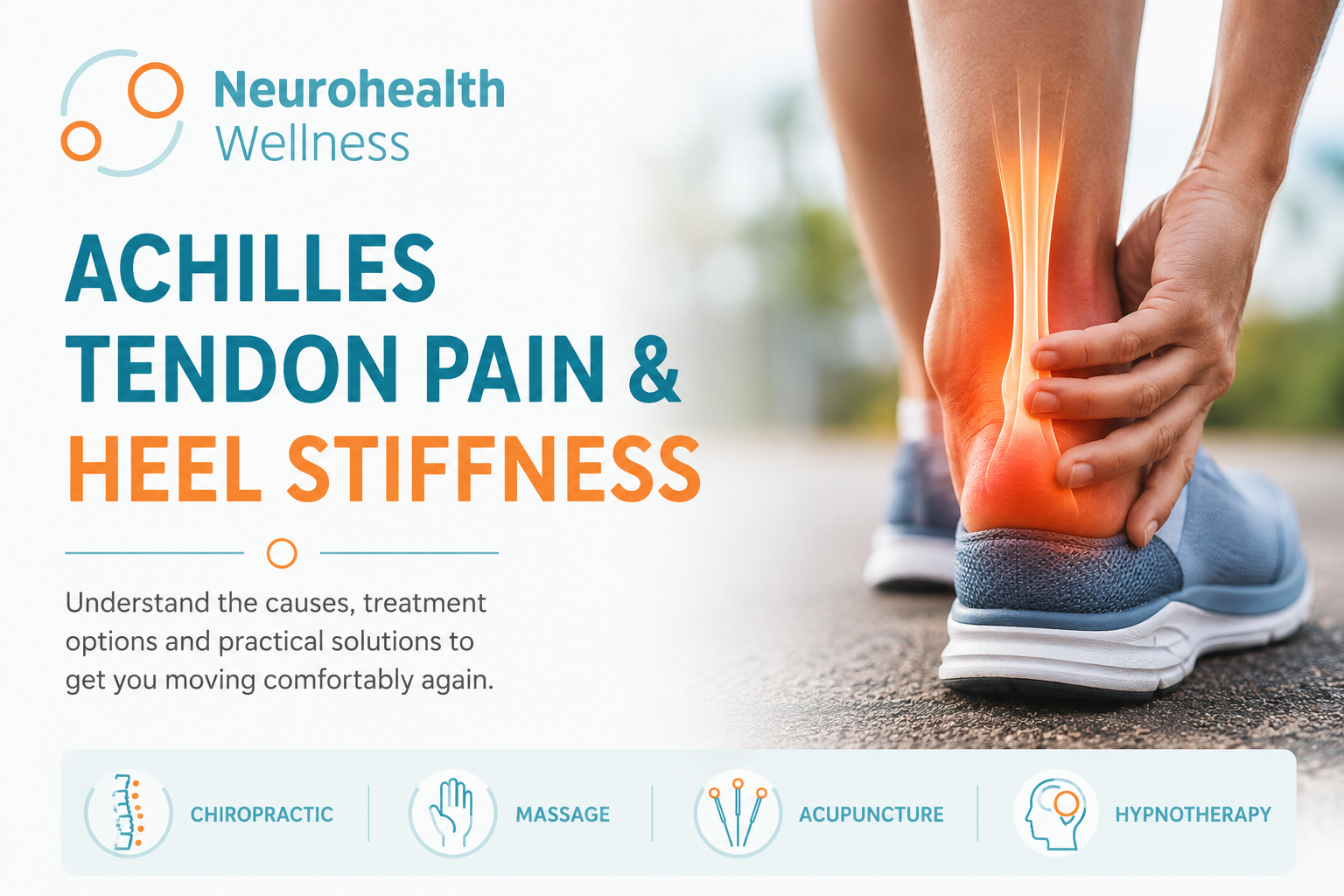
Achilles Tension: Why Your Heel Pain Isn’t a Stretching Problem
That First Step in the Morning Shouldn’t Hurt
You swing your legs out of bed, stand up… and there it is.
A sharp, stiff, almost tearing sensation right at the back of your heel.
You limp for the first few minutes. It “loosens up.” You ignore it.
Until it comes back the next morning… and the next… and the next.
Most people assume:
“My calves are tight. I just need to stretch more.”
But here’s the reality we see every day at Neurohealth Wellness on Sydney’s Northern Beaches:
If your pain is right above the heel, aggressive stretching may actually be making it worse.
This isn’t just tightness.
This is Achilles tendinopathy — and it’s a mechanical problem, not just a flexibility one.
The Anatomy: Your Body’s Most Powerful Spring
The Achilles tendon connects your calf muscles (gastrocnemius and soleus) to your heel bone.
It’s the thickest and strongest tendon in the human body.
Its job:
- Absorb load when you land
- Store elastic energy
- Propel you forward when you walk, run, or jump
Think of it like a high-tension spring system.
But like any spring…
if you keep it under constant strain, it starts to fray.
The Real Problem: Chronic Shortening of the Calf System
Modern life quietly changes your mechanics:
- Heeled shoes (even slight elevation)
- Sitting all day with toes pointed down
- Minimal barefoot or full-range movement
- Constant low-grade tension through the calves
Over time:
👉 Your calf muscles adaptively shorten
👉 They pull constantly on the tendon
👉 The tendon sits under permanent load
This is where the breakdown begins.
The Biomechanical Trap: Why Stretching Backfires
Here’s the mistake most people make:
They feel tight → so they stretch harder.
But if the tendon is already irritated or micro-damaged:
- Aggressive stretching = more tensile load
- The tendon can’t absorb it
- Instead of lengthening… it micro-tears
This is especially true at the insertion point on the heel bone — the most common site of pain.
The Morning Pain Explained: Micro-Tearing in Real Time
When you sleep:
- Your foot drops into a relaxed position
- The tendon stiffens overnight
- Blood flow is reduced
Then morning comes:
You step down flat…
👉 The calf pulls
👉 The tendon resists
👉 The load spikes instantly
And you feel:
That sharp, tearing, “rusty” pain
That’s not just stiffness.
That’s a sensitised, overloaded tendon being forced to lengthen too quickly.
Why This Matters (The Neurohealth Perspective)
At Neurohealth Wellness, we don’t just look at the tendon.
We look at:
- Foot mechanics (arch function, toe strength)
- Ankle mobility
- Calf strength vs endurance
- Hip and pelvis control
- Nervous system load and recovery capacity
Because your Achilles isn’t failing on its own.
It’s part of a whole-body chain.
If that chain is imbalanced, the tendon becomes the weakest link.
How to Break the Cycle (The Right Way)
1. Warm It Before You Load It
Before getting out of bed:
- Ankle circles
- Gentle foot pumps
- Light calf activation
This:
- Increases circulation
- Reduces stiffness
- Prevents that sudden load spike
2. Rebuild the Tendon (Don’t Just Stretch It)
The gold standard for tendon recovery:
👉 Eccentric loading
How:
- Stand on a step
- Rise up with both feet
- Slowly lower down on one foot
Why it works:
- Stimulates collagen repair
- Improves tendon strength
- Restores load tolerance
3. Restore Natural Foot & Calf Function
Instead of relying on passive support:
- Spend time barefoot (gradually)
- Strengthen intrinsic foot muscles
- Improve ankle mobility
- Reintroduce full-range movement
This aligns with our philosophy:
Your body heals when it moves well, not when it’s held together artificially.
4. Be Smart with Footwear
High-drop shoes:
- Keep calves shortened
- Increase tendon load over time
Transitioning to flatter shoes:
- Helps restore natural length
- Reduces chronic tension
⚠️ Important: This must be gradual.
When to Get Help
If you have:
- Persistent morning stiffness
- Pain during walking or running
- A thickened or tender Achilles
- Recurring flare-ups
…it’s time to look deeper.
At Neurohealth Wellness, our chiropractors assess:
- Full lower limb biomechanics
- Nervous system involvement
- Movement patterns contributing to overload
If your heel pain keeps coming back, don’t just stretch it harder.
👉 Book a New Patient Assessment to uncover the real cause:
https://www.neurohealthwellness.com.au/booking
📞 (02) 9905 9099
The Bigger Picture: This Isn’t Just a Tendon Issue
Achilles pain is often a signal that:
- Your movement system is overloaded
- Your tissues aren’t adapting well
- Your recovery isn’t keeping up with demand
This is where prevention matters.
Because waiting until it “tears properly” is not a strategy.
Final Thoughts: Stop Fighting the Symptom
Your Achilles isn’t “tight.”
It’s overworked, underprepared, and mechanically stressed.
Stretching alone won’t fix that.
Better movement will.
Better loading will.
Better understanding will.
Ready to fix your heel pain at the source?
👉 Book your assessment today:
https://www.neurohealthwellness.com.au/booking
Let’s rebuild your movement from the ground up.


