


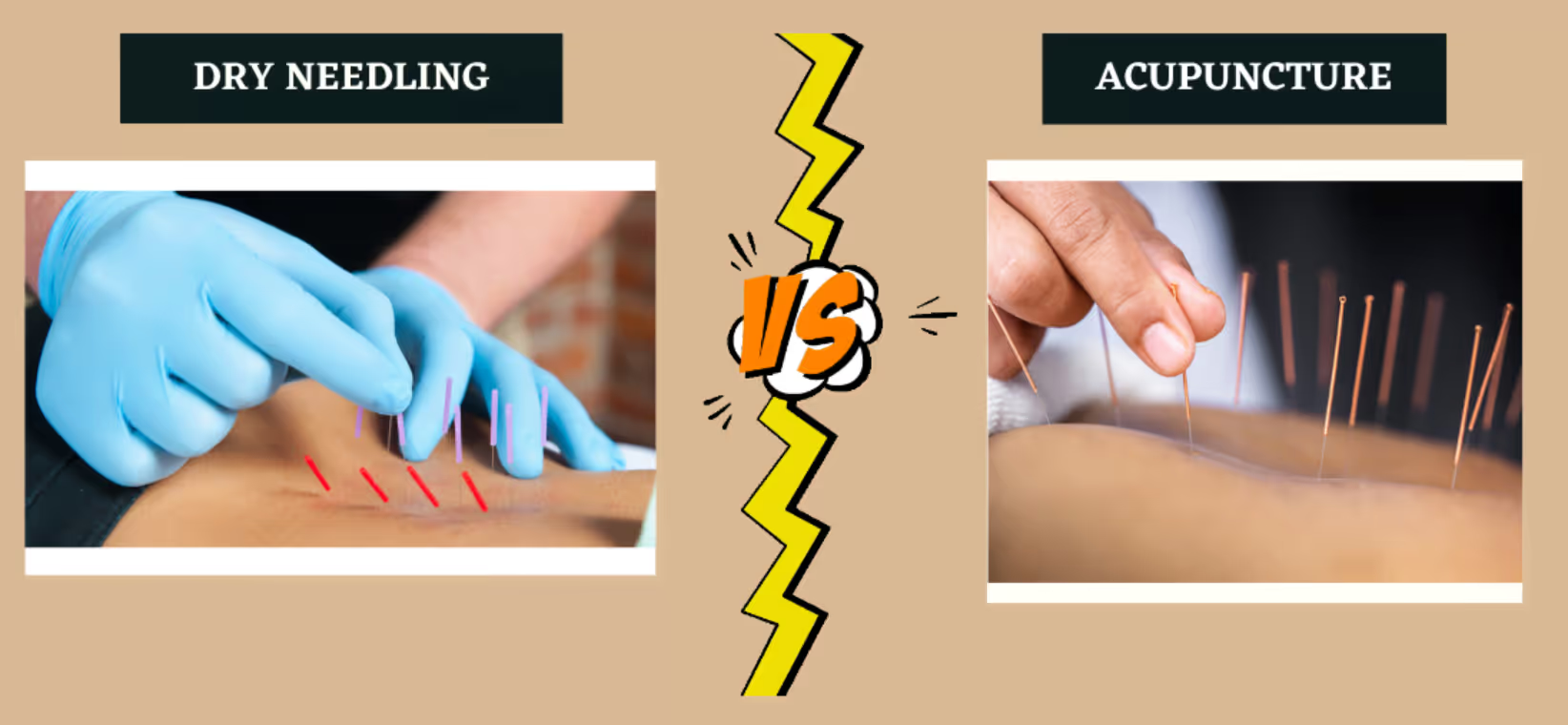
Is Dry Needling Acupuncture at All?
A Contemporary Scientific Re-Examination of Two Techniques Often Confused — But Rarely Compared
At Neurohealth Wellness on Sydney’s Northern Beaches, we provide both dry needling (performed by our chiropractors and Ana, our massage/myotherapist) and acupuncture (provided by Lucia).
Because both use a fine, solid filiform needle, they are often assumed to be interchangeable.
Modern anatomical, electrophysiological, and pain-science research paints a very different picture.
Despite sharing a tool, dry needling and acupuncture arise from different origins, target different tissues, produce different mechanical effects, and trigger different neuroimmune responses. They sit alongside each other as valuable therapies — but not as variations of the same method.
This review answers a common question:
Is dry needling a form of acupuncture?
Modern evidence says no.
Both therapies, however, have immense therapeutic value when applied appropriately — which is exactly why Neurohealth Wellness offers both.
A Simple Needle, Two Very Different Ideas
To the untrained eye, both practices appear similar:
- A thin needle enters the skin
- A therapeutic response follows
Clinically and biologically, however, they emerge from separate lineages with distinct intentions and mechanisms.
Acupuncture: Systemic Regulation
Rooted in East Asian medicine, acupuncture developed within a framework of meridians, channels, and pattern diagnosis.
Modern biomedical reinterpretations have mapped many acupuncture points to:
- Neurovascular bundles
- Dermatomes
- Connective tissue planes
- Lymphatic intersections
- Autonomic and visceral reflex arcs
Its therapeutic goal is systemic regulation — influencing autonomic balance, central pain modulation, and internal homeostasis.
Dry Needling: Local Structural Reset
Dry needling evolved from Western pain science and the study of myofascial trigger points (MTrPs).
These are not symbolic points. They are:
- Dysfunctional motor endplate zones
- Regions of spontaneous electrical activity (SEA)
- Hypercontracted sarcomeres and taut bands
- Sites of local ischaemia and nociception
Dry needling aims to directly deactivate a dysfunctional structure that perpetuates pain and movement restriction.
The difference is anatomical, physiological, and intentional — not cultural.
What Exactly Do They Target?
Acupuncture Targets: Global Regulatory Points
Acupuncture points are selected based on pattern diagnosis rather than local tissue pathology.
Even when applied locally, acupuncture often produces systemic effects, including:
- Autonomic modulation
- Vagal activation
- Central nervous system regulation
Research shows many points lie along intermuscular septa, connective tissue planes, and neurovascular pathways.
Their purpose is regulation.
Dry Needling Targets: Dysfunctional Myofascial Structures
Dry needling is unapologetically local and anatomical.
It targets:
- A palpable taut band
- A hypercontracted sarcomeric region
- An electrically active motor endplate
- A structure capable of reproducing the patient’s pain
The target is pathological tissue, not a symbolic point.
This is the most significant distinction between the two approaches.
Mechanotransduction: How Tissue Responds to the Needle
Acupuncture: Fascial Signalling
Research led by Helene Langevin and expanded through 2020–2023 shows acupuncture produces:
- Fascial winding
- Fibroblast stretching and remodelling
- Piezoelectric signalling in connective tissue
- Slow, long-range mechanical propagation
These effects help explain acupuncture’s systemic influence.
Dry Needling: Microdisruption & Normalisation
Dry needling behaves more like a precise microsurgical intervention:
- Mechanical disruption of contraction knots
- Restoration of normal sarcomere length
- Normalisation of excessive acetylcholine at the motor endplate
- Ionic shifts reducing spontaneous electrical activity
This often triggers a local twitch response (LTR) — a hallmark of dry needling and a sign of neuromuscular resetting.
Mechanically, the two therapies operate in almost opposite ways.
🔹 Unsure which needle-based therapy is right for your pain?
Dry needling and acupuncture serve different clinical purposes. Choosing the right one depends on whether your pain is being driven by a local dysfunctional structure or a broader nervous system pattern.
A thorough assessment can help determine which approach — or combination — best supports your recovery.
📍 Neurohealth Wellness – Allambie Heights (Northern Beaches)
📞 (02) 9905 9099
🔗 Book online: https://www.neurohealthwellness.com.au/booking
At Neurohealth Wellness, both approaches are used intentionally — dry needling to address local muscle and neuromuscular dysfunction, and acupuncture to influence broader nervous system and physiological responses — depending on what the person in front of us actually needs.
Electrophysiology: The Sharpest Scientific Distinction
Acupuncture Influences:
- A-delta and C-fibres
- Descending inhibitory pain pathways
- Limbic and cortical modulation
- Diffuse noxious inhibitory control (DNIC)
- Autonomic and vagal activation
Its effects are central and widespread.
Dry Needling Influences:
- Motor endplates (a domain acupuncture does not target)
Electromyography studies (2020–2024) demonstrate:
- Abolition of spontaneous electrical activity
- Elimination of endplate noise
- Triggered local twitch responses
- Reduced nociceptive input from MTrPs
- Segmental spinal modulation via proprioceptive change
Acupuncture has never been shown to extinguish SEA — because it does not aim for dysfunctional motor endplates.
Dry needling’s electrophysiological signature is unique.
Neuroimmune Effects: Different Chemical Messages
Acupuncture Produces:
- Vagal anti-inflammatory activation
- Endorphin and serotonin release
- Mast-cell mediated vasodilation
- HPA axis modulation
Dry Needling Produces:
- ↑ IL-10 (local anti-inflammatory cytokine)
- ↓ IL-6 and ↓ TNF-α
- Satellite cell activation for myogenic repair
- Improved perfusion of taut bands
- Reduced local C-fibre sensitisation
The immune system responds differently because the target tissue and insult differ.
Clinical Logic: Why Each Technique Is Chosen
Acupuncture is selected when addressing:
- Systemic pain modulation
- Digestive or hormonal patterns
- Stress, sleep, or autonomic imbalance
- Emotional or visceral regulation
Dry Needling is selected when addressing:
- Trigger points
- Muscle guarding
- Movement restriction
- Sports injuries
- Postural overload
- Neck or low back pain
If acupuncture adjusts the orchestra,
dry needling fixes a misfiring instrument.
Both matter — for different reasons.
Why the Confusion? The Thin Needle Problem
The only thing these therapies share is the instrument.
If the tool defined the therapy:
- A lumbar puncture would be acupuncture of CSF
- Joint aspiration would be acupuncture of synovium
- Percutaneous tenotomy would be acupuncture of tendons
Clearly, the target and mechanism define the practice — not the needle.
Where Neurohealth Wellness Stands
At Neurohealth Wellness, we value:
- Clarity
- Science-led care
- Choosing the right tool for the right person at the right time
Dry Needling at Neurohealth
Performed by:
- Steve (Chiropractor)
- Florian (Chiropractor)
- Ana (Massage/Myotherapist)
Acupuncture at Neurohealth
Performed by:
- Lucia (Acupuncture & Traditional Chinese Medicine)
Together, these therapies provide a complete spectrum of care:
local tissue repair + systemic nervous system regulation.
The Scientifically Defensible Conclusion
Dry needling is not acupuncture.
It is a distinct, evidence-based intervention targeting dysfunctional motor endplates and myofascial pathology.
Acupuncture is a system-level neuromodulatory therapy with global regulatory effects.
Both belong in modern healthcare.
Both are essential tools.
And both are integral to the integrative care model at Neurohealth Wellness.
🔹 Guidance matters as much as the technique
If you’re unsure whether dry needling, acupuncture, or a combination is most appropriate for your pain or condition, professional guidance can help clarify the best path forward.
📞 Call (02) 9905 9099
🔗 Book online: https://www.neurohealthwellness.com.au/booking
Scientific References
1. Dommerholt J. Phys Med Rehabil Clin N Am (2023).2. Shah JP, Thaker N. Curr Pain Headache Rep (2021).3. Sánchez-Infante J et al. Pain Med (2022).4. Langevin HM et al. Front Pain Res (2021).5. Yu S, Wang Y. Neurosci Bull (2020).6. Liu L et al. Clin Rehabil (2022).7. Butts R, Dunning J. JMMT (2021).8. Fernández-de-las-Peñas C. J Clin Med (2023).9. Zhao ZQ. Pain Reports (2020).10. Kietrys DM. JOSPT (2024).


