


Why Your Back Pain Isn’t Actually a Back Problem
Have you ever stood up after sitting and felt that deep, stiff, “locked” feeling in your lower back?
Or noticed your back feels constantly tight, overloaded, and fatigued—despite stretching, massage, or even treatment?
At Neurohealth Wellness, we see this every day across the Northern Beaches—from Brookvale to Manly, Dee Why to Allambie Heights.
And here’s the truth:
👉 Most chronic low back pain isn’t coming from your spine.
👉 It’s coming from a silent tug of war happening in your pelvis.
A battle between two key muscles:
- The glutes (your body’s powerhouse)
- The psoas (your deep hip controller)
When this balance is lost, your back becomes the casualty.
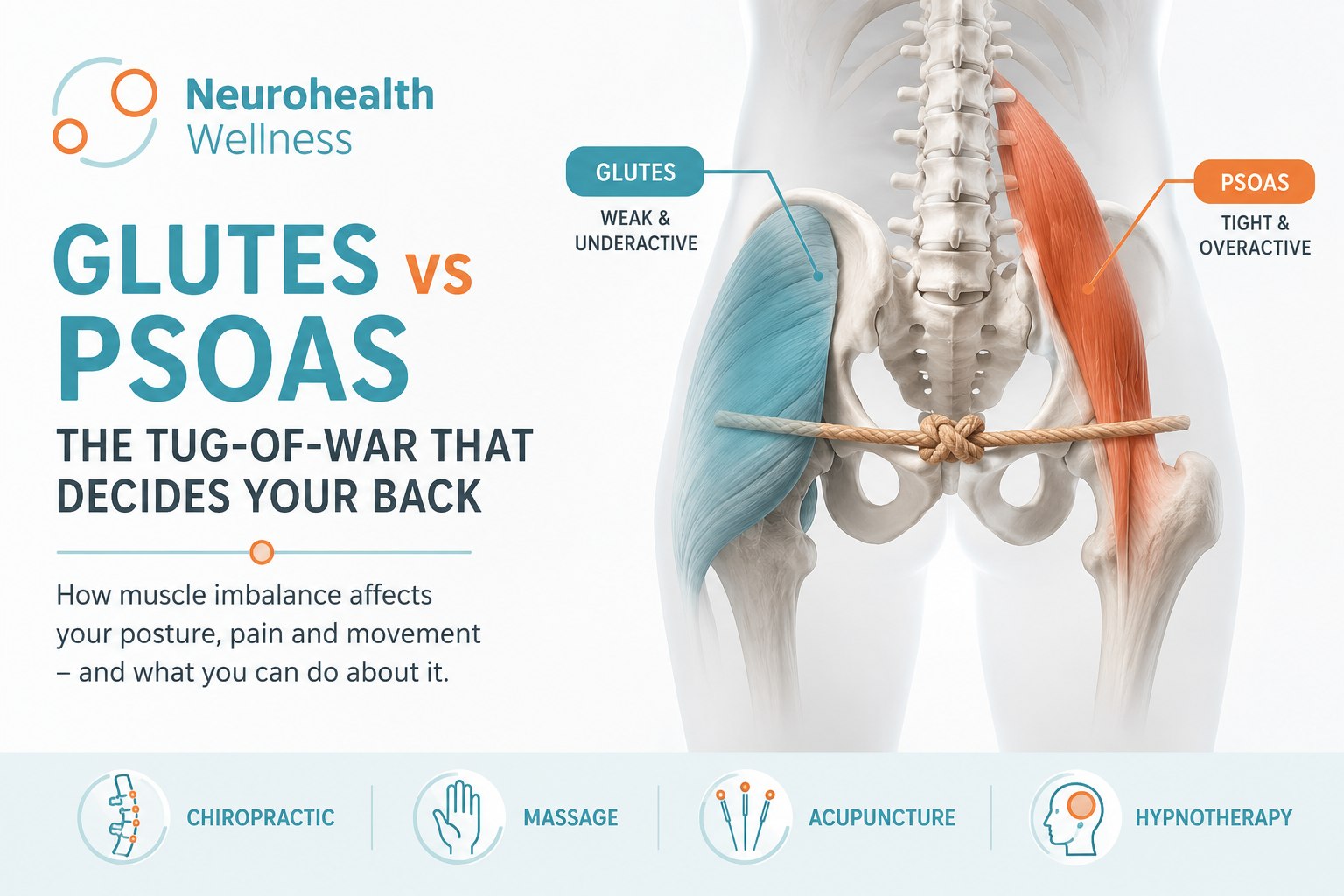
The Tug of War Inside Your Body
Think of your pelvis like the centre of a tug of war rope.
On one side: The Glutes
- The largest and most powerful muscles in your body
- Drive walking, running, lifting, and standing
- Stabilise your pelvis and protect your spine
On the other side: The Psoas
- Deep, smaller muscle connecting spine to hip
- Flexes your hip (brings your knee up)
- Pulls your pelvis forward
👉 When both are working together:
- Your pelvis stays balanced
- Your hips move smoothly
- Your lower back stays relaxed and supported
This is what we call efficient movement.
Modern Life Is Rigged Against You
Here’s where things start to fall apart.
Your Psoas Is Winning (Without Trying)
Every hour you sit:
- Your hips stay flexed
- Your psoas stays shortened
- Your brain learns: “this is normal length”
Do that:
- 8+ hours per day
- 5 days per week
- For years…
👉 Your psoas becomes:
- Short
- Stiff
- Overactive
Not stronger—just dominant.
Your Glutes Are Switching Off
At the same time:
- Your glutes are compressed into a chair
- They’re not being used
- They’re not being challenged
Your brain adapts:
👉 “We don’t need this muscle right now.”
So it:
- Reduces activation
- Decreases strength output
- Puts the glutes on standby
This is often called glute inhibition.
When the Tug of War Is Lost
Now the imbalance is set.
- The psoas pulls forward
- The glutes don’t pull back
What happens next?
1. Your Pelvis Tilts Forward
- Increased anterior pelvic tilt
- Excessive lumbar curve
2. Your Lower Back Takes the Load
- Increased compression on discs
- Increased shear forces
- Constant low-level tension
3. Your Back Becomes the Engine
Instead of your glutes driving movement:
👉 Your lower back compensates with every step
Like a rowing team where the strongest rower stopped rowing:
- The boat still moves
- But everyone else burns out
This Is Why Your Back Always Feels “Tight”
That constant tightness?
👉 It’s not because your back is weak.
👉 It’s not because you need more stretching.
It’s because your back is:
Overworking to compensate for a system imbalance.
At Neurohealth Wellness, this is a core principle we see across:
- Chronic low back pain
- Hip tightness
- Recurrent flare-ups
- “Nothing works” cases
Why Stretching Alone Doesn’t Fix It
Many people think:
👉 “I just need to stretch my hip flexors (psoas).”
And yes—this helps.
But it’s only half the equation.
If you:
- Stretch the psoas
- But don’t reactivate the glutes
👉 You’ve just loosened one side of the rope…
👉 Without restoring strength on the other.
The imbalance remains.
The Neurohealth Approach: Restore the Balance
At Neurohealth Wellness, we don’t chase symptoms—we restore systems.
The real solution is:
1. Reduce Psoas Dominance
- Targeted mobility work
- Postural reset strategies
- Nervous system downregulation
2. Reactivate the Glutes
- Functional strengthening
- Movement retraining
- Load through full ranges
3. Reintegrate Movement Patterns
- Walking mechanics
- Standing posture
- Lifting strategies
👉 This is where chiropractic care, rehab, and soft tissue work all come together.
If your back constantly feels tight, stiff, or overloaded—even when you’re “doing all the right things”—it’s time to look deeper.
👉 Book your New Patient Chiropractic Assessment
We’ll assess your movement, pelvis, and nervous system to uncover the real cause.
📍 Neurohealth Wellness – Northern Beaches
📞 (02) 9905 9099
🌐 https://www.neurohealthwellness.com.au/booking
What This Looks Like in Real Life
When this balance is restored:
- Your pelvis returns to neutral
- Your glutes take over as the engine
- Your lower back finally switches off
Patients often say:
👉 “My back just stopped feeling tight… without me doing anything crazy.”
Because nothing was “damaged.”
It was simply:
👉 An unbalanced system that needed recalibration.
How Our Team Can Help
At Neurohealth Wellness, our practitioners work together to restore this balance:
- Steve & Florian (Chiropractors): Restore spinal and pelvic alignment while addressing nervous system control
- Vivian (Chiropractor): Focuses on biomechanics and rehab to rebuild movement patterns
- Ana (Massage/Myotherapy): Releases overactive hip flexors and compensating muscles
- Lucia (Acupuncture): Helps regulate muscle tone and nervous system stress responses
This is whole-body care—not just symptom relief.
Prevention: The Key to a Pain-Free Future
The biggest mistake people make?
👉 Waiting until pain forces them to act.
Instead:
- Move regularly
- Break up sitting
- Strengthen your posterior chain
- Train your body the way it was designed
Because prevention is always easier than recovery.
If you’re dealing with:
- Chronic low back tightness
- Hip stiffness
- Pain that keeps coming back
👉 Don’t just treat the symptom.
Fix the tug of war.
📅 Book your assessment today:
https://www.neurohealthwellness.com.au/booking
📞 (02) 9905 9099
References
- Neumann DA. Kinesiology of the Musculoskeletal System. 3rd ed.
- McGill SM. Low Back Disorders. Human Kinetics.
- Hodges PW, Richardson CA. Inefficient muscular stabilization of the lumbar spine. Spine.
- Sahrmann SA. Diagnosis and Treatment of Movement Impairment Syndromes.
- Comerford MJ, Mottram SL. Movement and stability dysfunction. Manual Therapy.
- Janda V. Muscle imbalance and chronic pain syndromes.


