


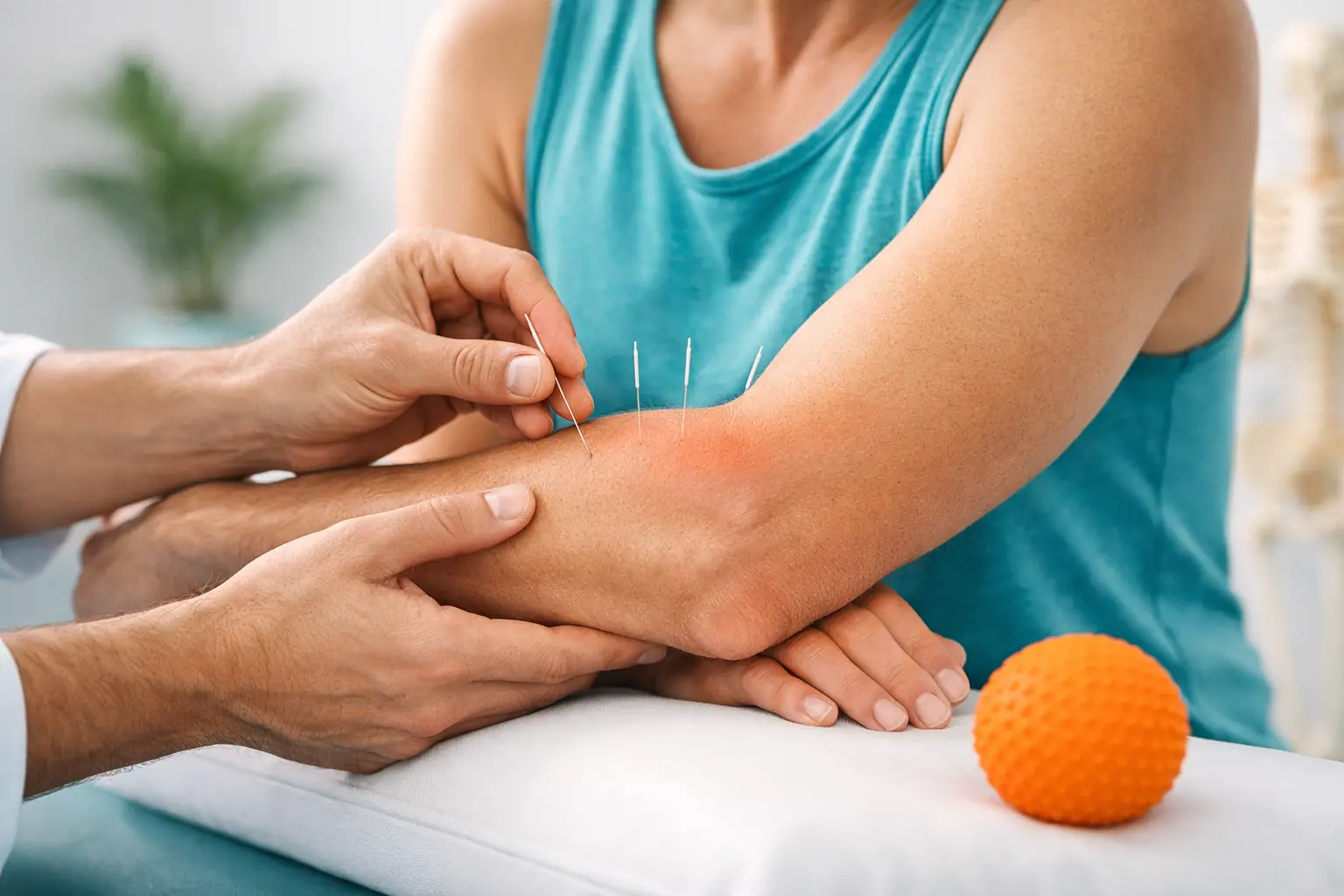
That sharp pull on the outside of your elbow often shows up at the worst time - when you lift a kettle, shake hands, type at work, or reach for a tennis racquet. If you have been wondering how dry needling treats tennis elbow, the short answer is that it helps reduce pain, release overloaded muscles, and support the body’s natural healing process so everyday movement feels easier again.
Tennis elbow can be frustrating because it is rarely just about the elbow itself. For many people, it builds slowly from repeated gripping, lifting, computer use, racquet sports, gym training, or hands-on work. The pain tends to settle around the outer part of the elbow, but the real strain often involves the forearm muscles, wrist extensors, shoulder mechanics, and the way the whole arm is being used.
What tennis elbow actually is
Tennis elbow, also called lateral elbow pain or lateral epicondylalgia, is an irritation of the tendons that attach the forearm muscles to the outside of the elbow. Despite the name, you do not need to play tennis to get it. We see it in office workers, tradies, gym-goers, parents lifting children, and active adults who use their hands and forearms a lot.
It usually develops when the tissues are being loaded more than they can comfortably handle. Sometimes that load comes from sport. Sometimes it comes from repetitive work, poor movement patterns, reduced shoulder support, or training too hard without enough recovery. The result is pain, weakness in grip, and tenderness that can linger for weeks or months if it is not properly addressed.
How dry needling treats tennis elbow in practice
Dry needling uses very fine sterile needles placed into tight, irritated, or overactive muscle tissue. In tennis elbow, that often means the forearm muscles that help extend the wrist and fingers, as well as nearby areas that may be contributing to ongoing tension.
The aim is not simply to needle the sore spot and hope for the best. A thoughtful treatment looks at the broader pattern. If the forearm is doing too much work because the shoulder is not stabilising well, or if repetitive gripping has left the muscles in a constant state of tension, those factors matter.
When the needle is applied to the right tissue, it can help calm local muscle guarding, improve circulation, and create a response that encourages the tissue to reset. Many patients describe a deep ache, a brief twitch, or a sense of release in the muscle. After treatment, the arm may feel looser, less tender, and easier to use.
For some people, pain relief comes quite quickly. For others, especially if the issue has been around for a while, it is more gradual. That is normal. Longstanding tendon irritation usually needs more than one session and often responds best when dry needling is combined with hands-on care and rehabilitation.
Why the forearm matters so much
The muscles along the top of the forearm do a surprising amount of work. They help stabilise the wrist when you grip, lift, carry, or type. When these muscles become overloaded, they can stay tight and tender, placing extra pull through the tendon attachment at the elbow.
Dry needling can help reduce that excessive tension. By targeting trigger points and shortened muscle bands, treatment may decrease the stress being transferred into the painful elbow region. This is one reason people often notice not only less elbow pain, but also better grip comfort and less fatigue through the forearm.
That said, tension is only one piece of the puzzle. If your workload, training volume, posture, or lifting mechanics stay the same, symptoms can return. Good care looks beyond temporary relief.
What a proper assessment should include
Before treatment begins, the elbow should be assessed in context. Pain on the outside of the elbow can look simple, but several factors can feed into it. Wrist movement, gripping strength, shoulder control, neck tension, training habits, and daily work demands all matter.
A whole-body approach is especially helpful when symptoms keep returning. For example, restricted shoulder movement may lead the forearm to compensate. Neck and upper back tension can change how the arm loads. Stress also plays a role, because when the nervous system is under strain, muscles often stay tighter and more reactive.
This is where an integrated clinic approach can be valuable. Dry needling may be one part of care, but it is often most effective when supported by soft tissue therapy, movement advice, strengthening work, and treatment that improves how the rest of the body is functioning.
How dry needling feels and what to expect after
Most people tolerate dry needling very well. The needles are extremely fine, and while some spots can feel sharp or achy for a moment, treatment is usually brief. If a twitch response occurs, it can feel strange but is commonly a sign the muscle has been stimulated.
Afterwards, you might feel lighter through the arm, or a little sore for 24 to 48 hours - similar to post-exercise soreness. That mild ache is usually temporary. Gentle movement, hydration, and following your practitioner’s advice can help you settle well after treatment.
The number of sessions needed varies. A newer case may respond faster than a problem that has been building for months. If the tendon is quite irritated, treatment intensity may need to be adjusted. This is not a situation where harder always means better.
How dry needling treats tennis elbow alongside rehab
Dry needling can be very effective, but it is rarely the entire answer on its own. Tendons generally do better when pain relief is paired with gradual strengthening. Once the tissue is less reactive, carefully chosen exercises help build tolerance so the elbow can handle daily tasks and sport more confidently.
This matters because tennis elbow is often a load-management problem. If the muscle is released but the tendon is never strengthened, the improvement may not hold. On the other hand, if exercises are introduced too aggressively while pain is still high, the elbow can flare up. Balance is key.
In practice, treatment may include dry needling to calm pain and reduce forearm tension, hands-on therapy to improve movement, and progressive rehab to restore grip strength, wrist control, and shoulder support. For some patients, therapies such as massage, myotherapy, or shockwave therapy may also be considered depending on the presentation.
Who may benefit most
Dry needling can suit a wide range of people with tennis elbow, including desk workers with repetitive mouse use, athletes, golfers, tennis players, people doing manual work, and parents carrying children or heavy bags. It can be particularly helpful when the forearm feels tight, tender, and overworked.
It may be less appropriate for some people depending on their health history, needle comfort, skin condition, or other medical considerations. A qualified practitioner should always check whether it is a good fit for you.
It is also worth saying that not every sore elbow is tennis elbow. If pain is severe, came on after a fall, includes numbness, or is not improving, a more detailed assessment is important.
Why a holistic approach tends to work better
Pain has a habit of becoming more complex the longer it hangs around. The tendon becomes irritated, surrounding muscles tighten, movement changes, and confidence drops. You may start avoiding the gym, changing how you lift, or pushing through pain because work still needs to be done.
That is why a holistic approach often leads to better outcomes than chasing symptoms alone. At Neurohealth Wellness, care can be shaped around the bigger picture - your sport, your work, your posture, your recovery, and the way your nervous system is handling stress as well as physical load.
When treatment is personalised, dry needling becomes more than a quick fix. It becomes part of a plan to reduce pain, improve movement, and help your body cope better with the demands you place on it.
When to seek support
If you have had elbow pain for more than a couple of weeks, if gripping is becoming harder, or if the discomfort keeps returning every time you train or work, it is worth getting it looked at. Early treatment is often easier than waiting until the area becomes highly irritated and stubborn.
You do not need to stop moving altogether, but you do need the right advice. The goal is to keep you active while helping the tissues settle and rebuild.
Tennis elbow can feel small at first, then gradually start interfering with work, sleep, training, and simple daily tasks. With the right hands-on care and a clear rehab plan, there is usually a very good path forward - and often it starts by understanding what your elbow has really been asking for.


