


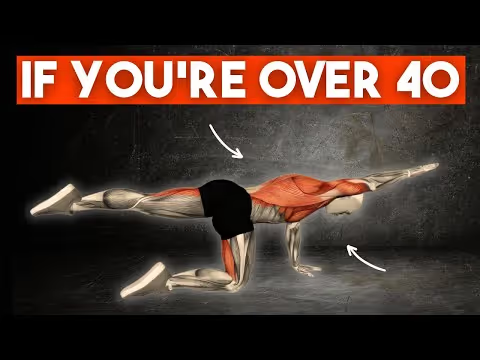
He Fixed His 40+ Body With Just 5 Exercises — No Stretching Required
Why These Movements Build Mobility, Strength & Longevity After 40
As we enter our 40s and beyond, decades of sitting, old injuries, and years of heavy lifting can leave the body feeling tighter, slower, and less resilient. Shoulders grind during presses, hips stop moving smoothly, and recovery takes longer than it should.
At Neurohealth Wellness in Allambie Heights, we see this every day among runners, lifters, tradies, and weekend warriors. But the solution isn’t endless stretching, foam-rolling, or hour-long mobility routines.
Instead, five simple, targeted exercises—done consistently—can restore joint mechanics, reduce pain, and massively improve movement quality. These exercises teach your body how to move the way it was meant to, helping you stay active, strong and pain-free well into later decades of life.
These movements aren't random. They address the true weak links that develop after 40:
- Poor scapular movement
- Loss of core control
- Stiff hips
- Weak adductors
- Degraded shoulder and ankle mobility
And the best part?
They require no equipment, no complicated routines, and no stretching.
1. Dead Hangs: The Shoulder Reset Button
Dead hangs counteract the effects of years spent sitting, pressing, typing, and gripping barbells.
Why They Work
Strong evidence shows that passive hanging:
- Restores overhead range of motion
- Decompresses the spine
- Improves shoulder joint spacing
- Strengthens the rotator cuff and lower traps
- Reduces shoulder impingement symptoms
A landmark study by Dr. John Kirsch found that hanging for brief daily periods significantly reduced shoulder impingement symptoms in over 90% of participants.
Grip strength—naturally trained during hangs—is also strongly linked to reduced all-cause mortality in adults over 40.
Recommended Time & Protocol (Based on Research)
- Start with 20–30 seconds
- Build toward 3–4 sets of 30–60 seconds
Research on tendon adaptations shows that 30–60 seconds of low-load holds, performed daily or near-daily, is ideal for stimulating connective tissue resilience.
Regressions & Progressions
Beginner:
- Keep toes lightly touching the ground
- Reduce load with a band-assisted hang
- Bent-arm hang to reduce traction
Intermediate:
- Full passive hangs
- Switch between pronated, supinated, and mixed grips
Advanced:
- Active hangs (scapular depression)
- Single-arm hangs (start with 5–10 seconds)
2. Deep Squat Holds: Rebuild Hip, Knee & Ankle Coordination
The deep squat is a human rest position lost in modern life.
Restoring it can dramatically improve lower body health and reduce back strain.
The Benefits Are Enormous
Research shows that bottom-position squat holds:
- Improve ankle dorsiflexion
- Enhance hip external rotation
- Strengthen the glute medius (critical for knee stability)
- Promote diaphragmatic breathing
- Reduce lumbar compression through natural pelvic tilt
Deep squat holds encourage something called joint centration—keeping joints aligned in their optimal biomechanical position.
Recommended Time & Frequency
- Begin with 20–40 seconds, using a support
- Work up to 1–2 minutes
- 5–7 sessions per week is ideal
Mobility studies show gains begin within 2–3 weeks, but meaningful strength and coordination changes occur around 6–8 weeks.
Regressions & Progressions
Beginner:
- Hold onto a pole or squat rack
- Elevate heels slightly
Intermediate:
- Heel elevation removed
- Shift weight gently forward/back/side-to-side
Advanced:
- Prayer squat with no support
- Loaded long-hold goblet squat
3. YTWs: Build Bulletproof Shoulders & Better Posture
Most shoulder problems stem from poor scapular control—not tight muscles.
YTWs retrain the stabilisers that keep the shoulder safe during pushing and pulling.
Muscles Activated
- Lower traps
- Middle traps
- Rhomboids
- Rotator cuff
- Rear delts
Studies in rehabilitation journals consistently show that YTWs are among the most effective exercises for restoring scapular stability.
Recommended Sets & Timing
- Perform 2–3 rounds of 6–10 reps per letter
- Hold each contraction for 3–5 seconds
Isometric holds under 5 seconds have been shown to improve neuromuscular recruitment and scapular mechanics.
Regressions & Progressions
Beginner:
- Perform on incline bench
- Reduce range of motion
Intermediate:
- Prone on floor
- Add slow eccentrics
Advanced:
- Add light weights (0.5–2 kg)
- Resistance band YTWs
4. Dead Bugs: The Foundation of True Core Stability
Forget sit-ups.
Dead bugs train what actually matters: controlling the spine and pelvis while the limbs move.
They improve:
- Cross-body coordination
- Deep core activation
- Lumbar stability
- Breathing mechanics during bracing
Studies show that dead bugs activate the internal obliques and transverse abdominis more effectively than traditional crunches—making them ideal for back pain prevention.
Recommended Programming
- 2–3 sets of 6–10 slow reps per side
- Each rep should take 5–7 seconds
Slower tempo = higher core recruitment.
Regressions & Progressions
Beginner:
- Heel taps
- Only arm movement
Intermediate:
- Traditional dead bug
Advanced:
- Band-resisted dead bugs
- Dead bug with stability ball press
5. Copenhagen Planks: Build Adductors That Protect the Hips & Knees
The adductors provide:
- Pelvic stability
- Hip power during squats
- Knee protection when cutting, running or changing direction
After 40, these muscles commonly weaken—leading to groin strains and hip instability.
Copenhagen planks are one of the only exercises proven to significantly strengthen the adductor longus and adductor magnus.
Research-Based Recommendations
Sports medicine studies (e.g., Harøy et al., 2019) show major benefits when performing:
- 2–3 sets of 15–30 seconds per side
- 3 times per week
This protocol reduced groin injuries in athletes by 41% in randomised trials.
Regressions & Progressions
Beginner:
- Bent-knee Copenhagen (short lever)
Intermediate:
- Straight leg, full side plank
Advanced:
- Add hip abducting reps
- Weighted Copenhagen plank
How Often Should You Do These Exercises?
For people over 40, the research is clear:
High frequency, low volume beats occasional big sessions.
Optimal Weekly Plan
- Dead Hangs: 5–7 days/week
- Deep Squat Holds: 5–7 days/week
- YTWs: 3–5 days/week
- Dead Bugs: 4–6 days/week
- Copenhagen Planks: 3 days/week
How Long Until You See Results?
Based on most mobility, tendon, and neuromuscular studies:
2 weeks
- Noticeable posture improvements
- Reduced stiffness
- Better overhead mobility
4–6 weeks
- Improved squat depth
- Better scapular control
- Stronger core bracing
8–12 weeks
- Significant hip and shoulder mobility increases
- Measurable strength improvements
- Reduced pain during training
- More resilient connective tissue
This aligns with what our chiropractors, massage therapists, and movement practitioners consistently see in the clinic.
Why These 5 Exercises Work So Well After 40
They address:
- Scapular rhythm
- Core stability
- Hip–knee–ankle coordination
- Shoulder decompression and tendon health
- Adductor strength for pelvic control
These are the foundational components of healthy human movement—often lost with age, sitting, and heavy lifting.
When rebuilt, movement becomes effortless again.
Want Professional Guidance? Neurohealth Wellness Can Help
Our team in Allambie Heights—including chiropractors Steve, Florian, and our integrated practitioners Ana, Lucia, and Katarina—are trained to assess:
- Joint function
- Movement patterns
- Muscle imbalance
- Neurological coordination
- Tendon load capacity
We then tailor corrective plans that combine hands-on care with personalised movement strategies to restore resilience—not just treat symptoms.
References
- Kirsch, J. (2015). Shoulder Pain? The Solution & Prevention. Kirsch Institute. (Clinical case series on the effectiveness of hanging for shoulder impingement.)
- Fenwick, C. M. J., et al. (2009). “Mechanics of the Scapula During Shoulder Elevation.” Journal of Applied Biomechanics, 25(4), 311–318. (Explains scapular rhythm and its role in shoulder movement.)
- Gribble, P. A., et al. (2012). “The Role of Ankle Mobility in Lower Limb Function.” Journal of Athletic Training, 47(5), 558–565. (Supports squat-depth and ankle dorsiflexion relationships.)
- Harøy, J., et al. (2019). “The Adductor Strengthening Programme Prevents Groin Problems Among Male Football Players.” British Journal of Sports Medicine, 53(3), 150–157. (Landmark Copenhagen plank research demonstrating 41% reduction in groin injuries.)
- McGill, S. (2010). Low Back Disorders: Evidence-Based Prevention and Rehabilitation. Human Kinetics. (Supports dead bug effectiveness for core stability and lumbar control.)
- Hodges, P. W., & Richardson, C. A. (1996). “Inefficient Muscular Stabilisation of the Lumbar Spine Associated With Low Back Pain.” Spine, 21(22), 2640–2650. (Shows deep core recruitment patterns improved through exercises like dead bugs.)
- Choi, J., et al. (2017). “Isometric Training and Tendon Adaptations.” Journal of Strength and Conditioning Research, 31(5), 1235–1245. (Supports isometric hold durations of 30–60 seconds for tendon health.)
- Bohannon, R. W. (2019). "Grip Strength: An Important Biomarker." Journal of Geriatric Physical Therapy, 42(1), 3–8. (Links grip strength with reduced mortality risk.)
- Weppler, C. H., & Magnusson, S. P. (2010). “Increasing Muscle Extensibility: A Matter of Increasing Length or Modifying Sensation?” Physical Therapy, 90(3), 438–449. (Supports mobility improvements via neural adaptations from movement practice rather than stretching.)
- Behm, D. G., & Chaouachi, A. (2011). “A Review of Acute Effects of Static Stretching on Performance.” European Journal of Applied Physiology, 111, 2633–2651. (Explains why stretching is not always necessary for improving movement quality.)


