


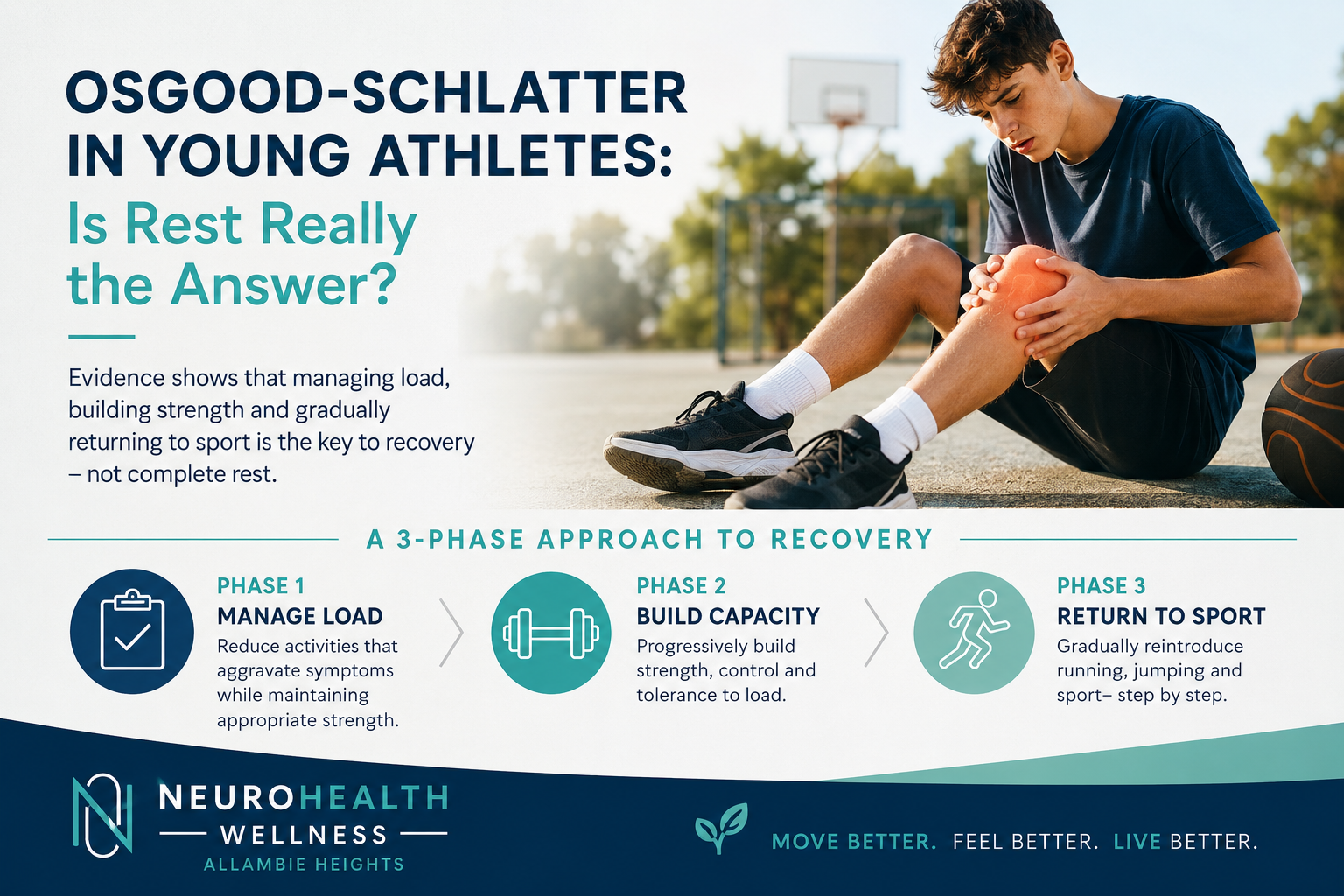
Osgood-Schlatter in Young Athletes: Is Rest Really the Answer?
Osgood Schlatter treatment has traditionally involved rest and waiting for symptoms to settle as a young athlete grows. But newer research suggests that managing activity, progressively strengthening the knee and gradually returning to sport may provide a better pathway than complete rest alone.
For years, young athletes experiencing Osgood-Schlatter disease have often been given a fairly simple piece of advice:
Rest, stop sport and wait for it to go away.
Because Osgood-Schlatter is associated with growth and commonly settles as adolescents mature, this approach can seem logical.
But does a young athlete really need to stop everything and simply wait?
Research suggests there may be a better way to manage Osgood-Schlatter - one that focuses on managing load, maintaining strength, progressively building the knee's capacity and gradually returning to sport rather than relying on complete rest alone.
For young athletes who want to keep playing basketball, football, netball, soccer, athletics or other running and jumping sports, that distinction can be important.
What Is Osgood-Schlatter Disease?
Osgood-Schlatter disease (OSD) is a growth-related overuse condition affecting the area at the front of the knee where the patellar tendon attaches to the tibial tubercle - the bony prominence just below the kneecap.
It commonly occurs during adolescence, particularly in active children involved in sports requiring repeated:
- running
- jumping
- sprinting
- kicking
- squatting
- rapid acceleration and deceleration.
Osgood-Schlatter affects approximately 1 in 10 adolescents and is particularly associated with physically active young people.
Typical symptoms include:
- pain or tenderness over the tibial tubercle
- pain during running and jumping
- discomfort with squatting or stairs
- pain when kneeling
- swelling or a prominent bump below the kneecap
- symptoms that become worse as sporting load increases.
Because the condition occurs during growth, parents are sometimes told their child simply needs to "grow out of it".
While Osgood-Schlatter will often improve as skeletal maturity occurs, symptoms can persist much longer than many families expect.
One long-term study found that some adolescents continued experiencing Osgood-Schlatter-related knee pain several years after their original diagnosis.
So although growth is part of the picture, persistent knee pain shouldn't automatically be dismissed as something a child simply has to tolerate until they finish growing.
Does Rest Help Osgood-Schlatter?
Reducing aggravating activity can certainly help settle symptoms.
But there is an important difference between complete rest and load management.
Resting from everything may reduce pain because less force is being placed through the irritated area. However, prolonged inactivity can also reduce strength and physical capacity.
Then a common problem occurs.
The knee feels better.
The athlete returns straight back to their previous training schedule.
The knee suddenly has to tolerate running, jumping, cutting and multiple training sessions again.
And the pain returns.
A better question may therefore be:
How much load can the knee currently tolerate, and how can we progressively increase that capacity?
That was the approach investigated in an important 2020 study by Rathleff and colleagues.
The 12-Week Osgood-Schlatter Study
Researchers followed 51 adolescents aged 10–14 years with Osgood-Schlatter disease through a structured 12-week management programme.
Importantly, these weren't children who had only recently developed knee pain.
Their average symptom duration before entering the study was approximately 21 months.
The programme combined four main elements:
- activity modification
- pain monitoring
- progressive strengthening
- graded return to sport.
Rather than simply telling young athletes to stop activity until the pain disappeared, the researchers attempted to gradually change how much load the knee could tolerate.
Phase 1 - Weeks 1-4: Reduce Irritating Load, But Don't Stop Everything
During the first four weeks, participants temporarily reduced sports participation and avoided activities that aggravated their symptoms.
This was the load-management phase.
The important part is that reducing sport didn't mean doing nothing.
The athletes continued lower-load exercises designed to help maintain muscle capacity.
Example 1: Static Quadriceps Hold
This was one of the exercises used in the Rathleff programme.
Sit with the knee positioned so the quadriceps can contract strongly without producing significant pain.
Example dose:
- 10 repetitions
- Hold for 30 seconds
- Relax briefly between repetitions
- Performed daily
- Total time under tension: approximately 5 minutes
The goal is to create meaningful muscular tension without the repeated impact associated with running and jumping.
Example 2: Double-Leg Bridge
Another exercise used during the initial phase of the study was the double-leg bridge.
Lie on your back with the knees bent and feet on the floor. Push through the feet and lift the hips while maintaining control through the trunk and pelvis.
Example dose:
- 3 sets × 10 repetitions
- Approximately 2 seconds lifting
- 2-second hold at the top
- 2 seconds lowering
- Approximately 6 seconds of controlled tension per repetition
- Approximately 60 seconds of time under tension per set
- Performed every second day
The bridge allows the athlete to continue strengthening the posterior chain and hip musculature while temporarily reducing knee loading.
Phase 1 Goal
The objective isn't necessarily to make the young athlete completely pain-free before they can do anything.
Instead, we're trying to reduce excessive load while maintaining physical capacity.
An activity ladder and pain-monitoring system can then help determine when the athlete is ready to progress.
The general principle used in the programme was to keep symptoms low — around 2/10 pain or less — while also making sure symptoms weren't worse the following morning.
If the knee becomes noticeably more painful afterwards or the following day, that's useful information.
The load may have exceeded the knee's current capacity.
Phase 2 - Weeks 5-12: Build Strength and Capacity
Once symptoms become more manageable, the goal starts to change.
Rather than continually protecting the knee from load, we progressively teach it to tolerate more load.
This is where strengthening becomes increasingly important.
The Rathleff programme progressed through three strengthening levels, moving towards increasingly demanding squat and lunge-based exercises.
Progression wasn't simply determined by the calendar.
The athlete needed to demonstrate that they could tolerate the current level before moving forward.
Here are some examples of what that progression might look like.
Level 1: Wall Squat Hold
Stand with the back against a wall and gradually slide down into a comfortable squat position.
Hold the position while maintaining good alignment through the hips, knees and feet.
Example dose:
- 4–5 sets
- 30–45 second holds
- 45–60 seconds rest between sets
- Total time under tension: 2–4 minutes
The athlete shouldn't necessarily chase the deepest possible position.
Start at a knee angle that can be controlled comfortably and progressively increase the challenge.
Level 2: Slow Bodyweight Squat
The next step can involve moving through a greater range rather than simply holding a position.
Example dose:
- 3 sets × 8–12 repetitions
- 3 seconds lowering
- 1-second controlled pause
- 2 seconds returning to standing
- Approximately 6 seconds per repetition
- 48–72 seconds time under tension per set
This slower tempo makes a relatively simple bodyweight squat considerably more challenging without immediately requiring heavy external resistance.
As strength improves, resistance can gradually be added.
Level 3: Split Squat
Split squats begin placing greater demand through each leg individually.
Example dose:
- 3 sets × 8 repetitions each side
- 3 seconds lowering
- 1-second pause
- 2 seconds rising
- Approximately 48 seconds time under tension per set on each side
Initially, the range can be shortened.
As tolerance improves, the athlete can progressively work through a greater range.
Level 4: Reverse Lunge
A reverse lunge introduces another progression towards the single-leg demands encountered in sport.
Example dose:
- 3 sets × 6–10 repetitions each side
- 2–3 seconds lowering
- Brief pause
- Controlled return
- Approximately 4–6 seconds per repetition
Again, the goal isn't simply to complete more repetitions.
We want quality movement, controlled loading and an appropriate symptom response.
How Do We Know When to Progress?
This is where the activity ladder and symptom monitoring become valuable.
Instead of saying:
"You've done two weeks of squats, so now you're ready to run."
We look at how the athlete actually responds.
Can they complete the exercise with good control?
Are symptoms staying within an acceptable range?
Is the knee settled afterwards?
How does it feel the next morning?
Can they tolerate the current level consistently?
If the answer is yes, the next progression may be appropriate.
If symptoms suddenly increase, it doesn't necessarily mean rehabilitation has failed.
It may simply mean:
the load progressed faster than the knee's current capacity.
We can temporarily reduce the load and build again.
Phase 3 - Gradually Reintroduce Running, Jumping and Sport
Eventually, strengthening in the gym needs to transfer back to the sporting environment.
This is where rehabilitation can sometimes go wrong.
The athlete has rested.
The knee feels better.
They can squat without much discomfort.
So they immediately return to full training and competition.
But there is an enormous difference between performing 10 controlled squats and completing a basketball game involving repeated sprinting, jumping, landing and changing direction.
Sport therefore needs its own progression.
In the Rathleff programme, return to sport wasn't introduced until the athlete had progressed sufficiently through the activity ladder.
A practical progression may look something like this.
Example 1: Low-Level Pogo Jumps
Small rhythmic jumps can begin reintroducing elastic loading.
Example dose:
- 3 sets × 15–20 seconds
- Approximately 30–40 contacts per set depending on rhythm
- 45–60 seconds rest
- 45–60 seconds total jumping exposure
Start with relatively small jumps.
The goal isn't maximal height.
It's teaching the athlete to tolerate repeated loading again.
Example 2: Controlled Squat Jumps
Once low-level jumping is well tolerated, jumping intensity can increase.
Example dose:
- 3 sets × 5 jumps
- Reset between each repetition
- Approximately 45–60 seconds rest
Focus on:
- controlled take-off
- soft landing
- knee alignment
- balanced landing position.
This isn't about fatigue.
It's about gradually rebuilding jumping capacity and confidence.
Example 3: Running Intervals
Running volume can also be progressively reintroduced.
For example:
- 1 minute easy running
- 1 minute walking
- Repeat 5 times
This provides approximately 5 minutes of running exposure.
If symptoms remain acceptable during the session and the following morning, running duration can gradually increase.
The next progression might be:
- 2 minutes running
- 1 minute walking
- Repeat 5 times
Then eventually continuous running.
Example 4: Sport-Specific Loading
For a basketball or netball player, the progression might eventually include:
Stage 1: Shooting and skills with minimal running.
Stage 2: Controlled jogging and movement drills.
Stage 3: Low-volume jumping and landing.
Stage 4: Change-of-direction drills.
Stage 5: Non-contact training.
Stage 6: Partial team training.
Stage 7: Full training.
Stage 8: Limited game minutes.
Stage 9: Full competition.
The exact progression will depend on the athlete and their sport.
Importantly, each stage becomes a test of capacity rather than simply another date on the calendar.
Pain Monitoring: A Useful Part of the Programme
One of the particularly practical elements was symptom monitoring.
The activity ladder used in the programme contained progressively more demanding activities.
The general principle was that symptoms should remain low - approximately 2/10 pain or less - and importantly, the knee should not be worse the following morning.
If symptoms increased significantly, the athlete could move backwards on the ladder rather than continuing to increase load.
This provides parents and young athletes with a much more useful framework than simply choosing between:
PLAY
or
REST.
Load can be adjusted.
Training volume can be reduced.
Jumping can temporarily decrease.
Running volume can change.
Strength work can continue.
And activity can progressively increase again as the knee becomes more tolerant.
What Happened After 12 Weeks?
The results were encouraging.
After 12 weeks:
80% of participants reported being improved or much improved.
Physical performance also increased.
Knee-extension strength increased by 32%.
Hip-abduction strength increased by 24%.
Jump height improved by 19%.
Jump distance improved by 14%.
Perhaps one of the most interesting findings, however, was return to sport.
Despite 80% reporting improvement after 12 weeks, only 16% had returned to playing sport at that point.
At 12 months, 90% reported a successful outcome and 69% had returned to sport.
That tells us something important.
Feeling better and being ready for full sport are not necessarily the same thing.
Returning a young athlete to sport can take time, particularly when symptoms have already been present for months or years.
This Doesn't Mean the Study Proved One "Cure"
There is an important limitation to understand.
The Rathleff research was a prospective cohort study, not a randomised controlled trial comparing the programme directly against complete rest or another treatment.
That means we can't say that this specific programme has been definitively proven to be the best treatment for every young athlete with Osgood-Schlatter.
A 2021 systematic review also highlighted the limited amount of high-quality research comparing specific exercise programmes for Osgood-Schlatter.
More recent evidence continues to support non-operative management while highlighting the need for further high-quality research into which rehabilitation approaches work best.
So the evidence shouldn't be interpreted as:
"This exact exercise programme cures Osgood-Schlatter."
A more accurate message is:
Structured load management and progressive rehabilitation provide a promising alternative to simply telling every young athlete to stop sport and wait.
What This Means for Young Athletes
For an active child with Osgood-Schlatter, the goal isn't necessarily to remove every form of physical activity.
Instead, management may involve identifying which activities are exceeding the knee's current capacity.
For example, a young basketball player might tolerate shooting practice and controlled strength work but struggle with repeated jumping, sprinting and three consecutive days of training.
Another athlete may tolerate training twice per week but flare when school sport, club training, games and additional running are combined.
This is why the total weekly load matters.
A rehabilitation plan may involve temporarily reducing the activities that cause the greatest irritation while maintaining appropriate strength, conditioning and movement.
As symptoms improve and strength increases, load can progressively return.
Why Strength Matters
Young athletes don't only need their symptoms to settle.
They need their bodies to tolerate the demands of their sport.
A basketball or netball player may perform hundreds of accelerations, decelerations, jumps and changes of direction during training and competition.
A football or soccer player repeatedly runs, sprints, kicks and changes direction.
Simply resting until pain disappears doesn't necessarily prepare the knee for those demands.
Progressive strengthening aims to increase the athlete's ability to tolerate load before full sporting demands are reintroduced.
That can include progressively developing:
- quadriceps strength
- hip strength
- calf strength
- squat capacity
- single-leg control
- running tolerance
- jumping capacity
- landing control
- change-of-direction ability.
The exact programme should depend on the individual athlete, their symptoms, age, sport and current capacity.
Don't Assume Every Child's Knee Pain Is Osgood-Schlatter
This is particularly important.
Pain around the knee during adolescence isn't automatically Osgood-Schlatter.
A proper assessment should consider the location of symptoms, sporting load, growth stage, strength, movement and other possible causes of knee pain.
Seek professional assessment particularly when pain is:
- persistent or progressively worsening
- causing limping
- present at night or at rest
- associated with significant swelling
- associated with an acute injury
- limiting normal walking or daily activities
- preventing the child from participating in sport for an extended period.
Persistent pain in a growing child deserves an appropriate diagnosis rather than simply being labelled "growing pains."
The Take-Home Message
Osgood-Schlatter is common in young athletes, but that doesn't mean children necessarily need to completely stop activity and wait months for growth to finish.
A more active approach can be thought of in three phases:
PHASE 1 - MANAGE LOAD
Reduce the activities currently exceeding the knee's capacity while maintaining appropriate low-load strength.
PHASE 2 - BUILD CAPACITY
Progressively increase strength, range, resistance and time under tension as the knee becomes more tolerant.
PHASE 3 - RETURN TO SPORT
Gradually reintroduce running, jumping, landing, change of direction, training and eventually competition.
The important word throughout all three phases is progressive.
We aren't trying to protect the knee from load forever.
We're trying to determine how much load it can currently tolerate and progressively increase that capacity.
If your child has persistent pain around the knee or is struggling with a growth-related sporting injury, an assessment can help determine what's causing the symptoms and whether a structured rehabilitation and load-management programme may be appropriate.
At Neurohealth Wellness in Allambie Heights, we work with young athletes from across Sydney's Northern Beaches to assess musculoskeletal and sporting injuries and develop individual management and rehabilitation plans.
The aim isn't simply to get the pain down.
It's to help young athletes build the strength, capacity and confidence to get back to doing what they love.
References
- Rathleff MS, Winiarski L, Krommes K, et al. Activity Modification and Knee Strengthening for Osgood-Schlatter Disease: A Prospective Cohort Study. Orthopaedic Journal of Sports Medicine. 2020;8(4):2325967120911106.
- Neuhaus C, Appenzeller-Herzog C, Faude O. A systematic review on conservative treatment options for Osgood-Schlatter disease. Physical Therapy in Sport. 2021;49:178–187.
- Guldhammer C, Rathleff MS, Jensen HP, Holden S. Long-term Prognosis and Impact of Osgood-Schlatter Disease 4 Years After Diagnosis: A Retrospective Study. Orthopaedic Journal of Sports Medicine. 2019;7(10).
- Rathleff MS, et al. Treatments for Osgood Schlatter Disease: A Systematic Review of the Literature. Orthopaedic Journal of Sports Medicine. 2026.
Important: The exercises, sets, repetitions and progressions above are examples and are not intended as an individual rehabilitation prescription. Exercise selection and loading should be adjusted according to the young athlete's symptoms, diagnosis, stage of growth, strength and sporting demands. Persistent or worsening knee pain in a child or adolescent should be appropriately assessed.


