


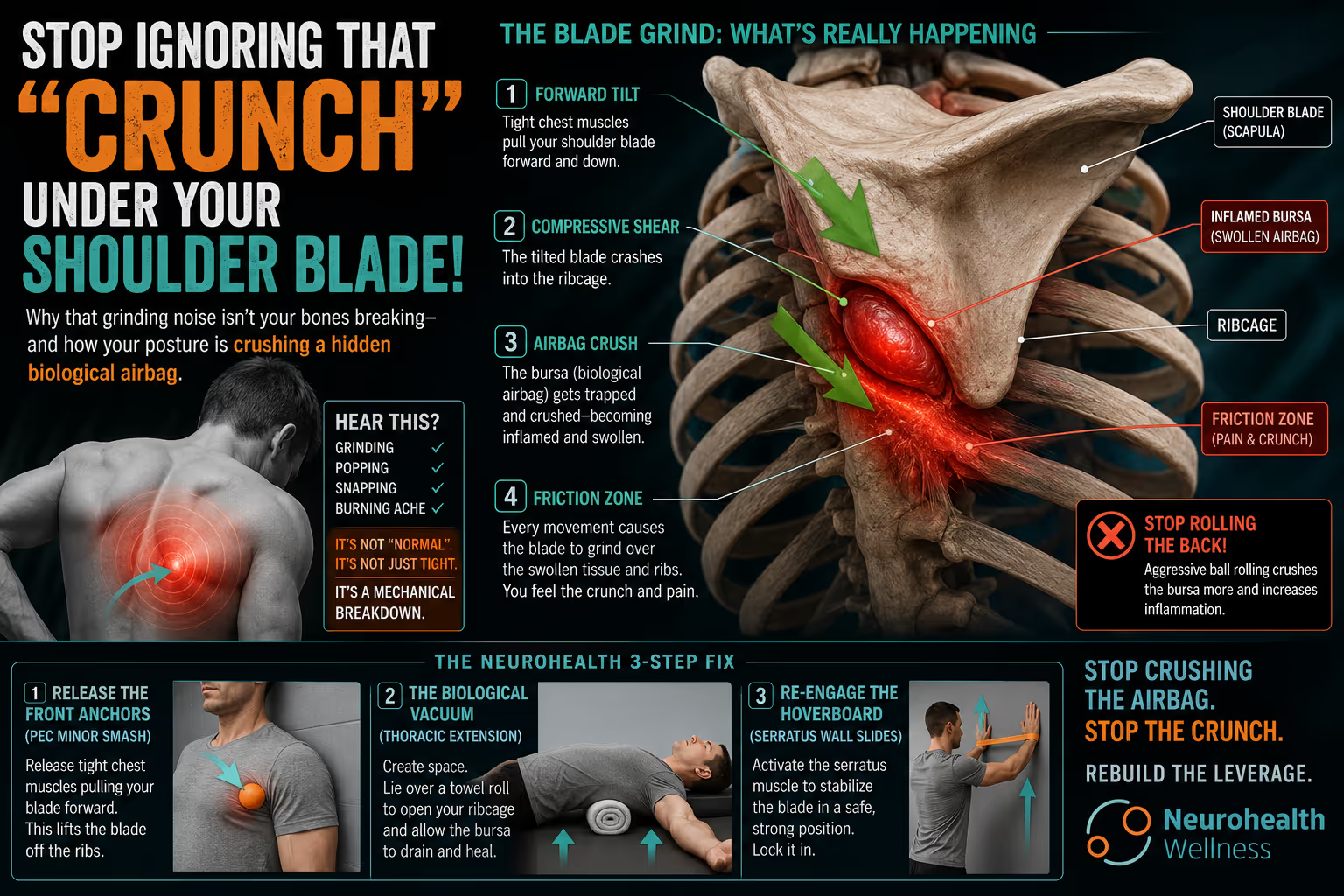
🛑 STOP IGNORING THAT “CRUNCH” UNDER YOUR SHOULDER BLADE
Why that grinding noise isn’t your bones—and what your body is really telling you
The Painful Truth Most People Miss
If you’ve ever felt:
- A grinding, crunching, or popping under your shoulder blade
- A deep burning ache in your upper back
- Discomfort when leaning against a chair or lying flat
- Pain when lifting your arm, doing push-ups, or reaching overhead
You’re likely not dealing with a “tight muscle” or simple knot.
This is commonly known as Snapping Scapula Syndrome — but at Neurohealth, we look deeper.
👉 This is a movement and nervous system problem, not just a tissue problem.
The Neurohealth Perspective: A Breakdown in Movement, Not Structure
Your shoulder blade (scapula) is one of the most unique structures in your body.
It doesn’t attach like a typical joint.
Instead, it floats and glides over your ribcage.
Think of it as a high-performance gliding system, designed for:
- Smooth movement
- Force transfer
- Shoulder stability
- Efficient upper body strength
But here’s where things go wrong…
What’s Actually Happening Under the Shoulder Blade
Between your shoulder blade and ribcage sit small fluid-filled structures called bursae.
These act like biological shock absorbers, allowing friction-free movement.
When everything is working well:
✔️ The scapula glides silently
✔️ Muscles coordinate smoothly
✔️ Load is distributed efficiently
When things break down:
❌ The scapula loses position
❌ The space between blade and ribs decreases
❌ The bursa becomes compressed and inflamed
That “crunch”?
👉 It’s bone scraping over irritated tissue and rib surfaces.
Why Modern Life Is Driving This Problem
This isn’t bad luck—it’s predictable.
Your daily habits are training your body into this pattern.
The Real Root Cause: Forward Shoulder Posture
Hours of:
- Sitting at a desk
- Driving
- Looking down at your phone
- Gym training without proper control
…lead to:
- Tight chest muscles
- Weak upper back stabilisers
- Poor scapular control
This creates a forward-tilted shoulder blade, which:
- Reduces space under the scapula
- Increases compression on the bursa
- Creates a high-friction zone
The Bigger Picture: It’s Not Just Your Shoulder
At Neurohealth, we always zoom out.
This issue is rarely isolated.
It’s often connected to:
- Thoracic spine stiffness
- Ribcage restriction
- Neck dysfunction
- Poor breathing mechanics
- Even foot and lower body movement patterns
👉 This is why we take a full-body, neurological approach.
(You’ll see similar patterns in issues like 👉 “Neck Pain = Foot Problem” and “Fascia, Movement and Posture: Why Pain Persists”.)
Why Massage Balls Can Make It Worse
Let’s clear this up.
Rolling aggressively on a ball under your shoulder blade might feel like you’re “doing something”…
But in many cases, it’s making things worse.
Why?
Because you’re:
- Compressing already irritated tissue
- Increasing inflammation
- Reinforcing the problem
👉 You’re treating the symptom—not the cause.
The Neurohealth Way: Restore Movement, Don’t Fight Pain
We don’t chase pain.
We restore function.
Here’s how we approach this clinically:
1. Release What’s Pulling You Forward
The chest—especially the pec minor—is often the hidden driver.
When tight, it pulls the shoulder blade forward and down.
What to do:
- Gentle ball work on the upper chest (not the back)
- Stretching the front of the shoulders
- Breathing into the chest to restore expansion
2. Restore Thoracic Movement
If your mid-back doesn’t move, your shoulder blade has nowhere to go.
What to do:
- Thoracic extension over a towel or roller
- Controlled breathing in extension
- Gentle mobility—not aggressive cracking
3. Rebuild Scapular Control
The key muscle here is the serratus anterior.
It keeps the shoulder blade flush and stable against the ribcage.
What to do:
- Wall slides with band tension
- Controlled upward rotation exercises
- Slow, intentional movement training
Why This Matters Long-Term
If left unchecked, this pattern can progress to:
- Chronic bursitis
- Shoulder impingement
- Rotator cuff overload
- Reduced strength and performance
In severe cases, people are even told they need surgery.
👉 But most cases respond incredibly well to movement-based care when addressed early.
Don’t Wait Until It Gets Worse
If you’re hearing or feeling that crunch under your shoulder blade, it’s a sign your body isn’t moving the way it should.
👉 Book a New Patient Chiropractic Assessment at Neurohealth Wellness
We’ll assess your movement, nervous system, and posture to find the real cause.
📍 Allambie Heights | Northern Beaches
📞 (02) 9905 9099
🌐 https://www.neurohealthwellness.com.au/booking
The Neurohealth Difference
At Neurohealth Wellness, we don’t just treat where it hurts.
We look at:
- How your brain controls movement
- How your joints load and adapt
- How your lifestyle shapes your body
Our chiropractors—Steve, Florian, and Vivian—combine:
- Hands-on care
- Movement retraining
- Nervous system-based strategies
To help you:
✔️ Move freely
✔️ Reduce pain naturally
✔️ Build long-term resilience
Final Thoughts: Stop Crushing the System
That crunch isn’t random.
It’s a signal.
Your body is telling you:
👉 “I’ve lost control. I’ve lost space. I need help.”
The goal isn’t to silence the noise.
The goal is to restore the system.
Ready to Fix the Cause, Not Just the Symptom?
If your shoulder blade is grinding, clicking, or painful—don’t ignore it.
👉 Book your assessment today and take the first step toward moving pain-free again.
📞 (02) 9905 9099
🌐 https://www.neurohealthwellness.com.au/booking
References
- Kuhn JE et al. (2009). Scapular Dyskinesis: Diagnosis and Treatment. JAAOS
- Warth RJ et al. (2015). Snapping Scapula Syndrome: Current Concepts Review. JBJS Reviews
- Kibler WB et al. (2013). Role of the Scapula in Athletic Shoulder Function. AJSM
- Ludewig PM & Reynolds JF (2009). The Association of Scapular Kinematics and Shoulder Pathology. JOSPT
- McClure PW et al. (2006). Shoulder Function and 3D Scapular Kinematics. Physical Therapy Journal
- Struyf F et al. (2014). Clinical Assessment of the Scapula. British Journal of Sports Medicine


