


Stretching Doesn’t Make You Flexible — Tissue Change Does: Why PAILs/RAILs Are the Missing Link
By Neurohealth Wellness — Northern Beaches Chiropractic & Allied Health
Most people believe flexibility comes from stretching longer, pushing harder, or holding a position until the muscle “loosens up.” But modern mobility science says something very different:
Stretching doesn’t make you flexible.
Changing your tissue does.
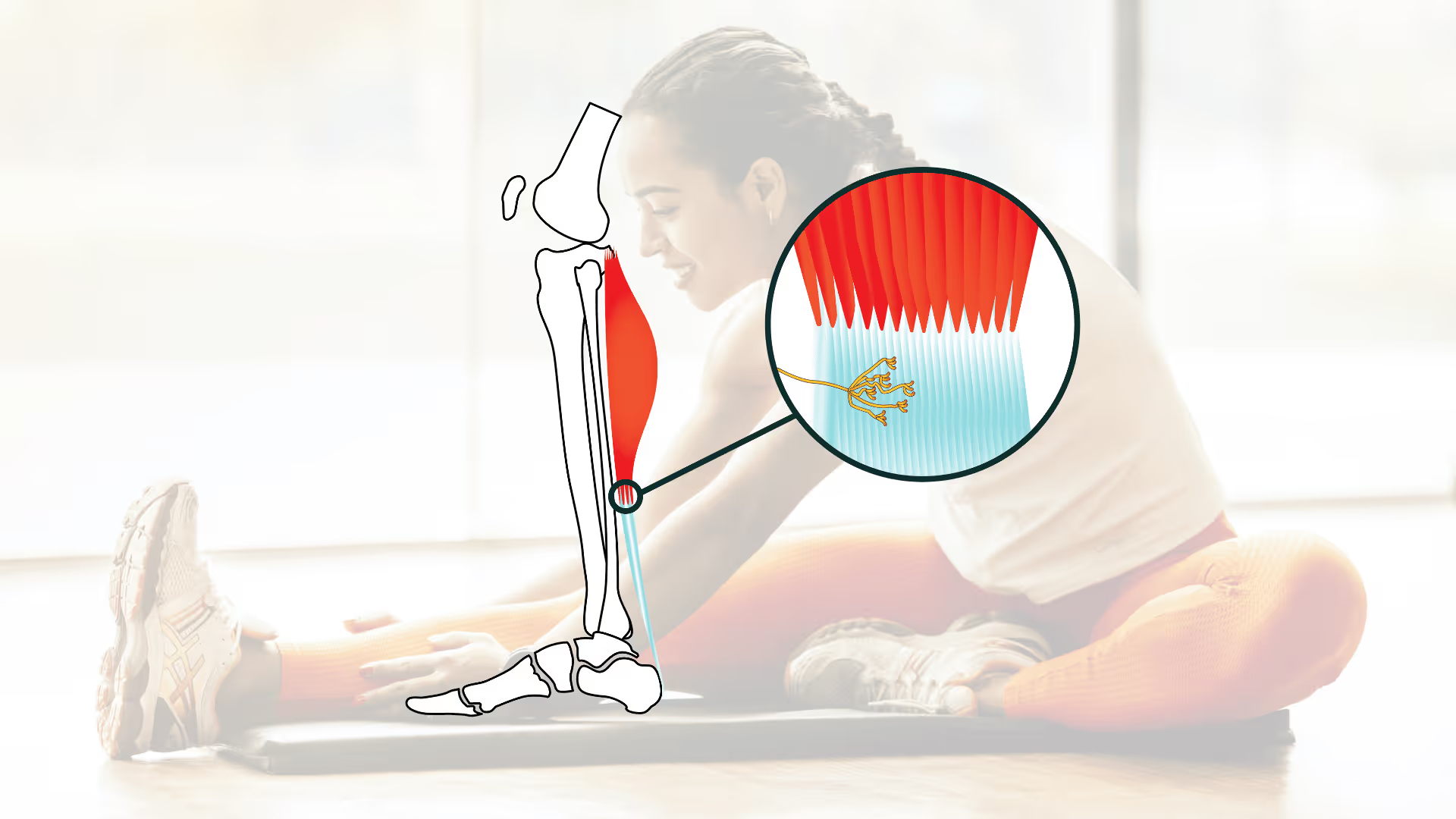
A major 2025 review on sarcomerogenesis (the process of adding sarcomeres in series inside muscle fibres) confirms that long-term flexibility isn’t created by passive stretch alone — it’s created by the right kind of stimulus:
- High tension in lengthened positions
- Active contractions at end-range
- Repeated exposure over weeks
This is exactly what the PAILs/RAILs system trains. And it’s why, at Neurohealth Wellness, we incorporate these techniques into rehabilitation, athletic performance programs, and injury-prevention strategies for our Northern Beaches community.
If you want lasting flexibility — the kind that stays with you and makes your body feel genuinely free — this blog will show you how it happens, why it works, and how we apply it in clinic.
Flexibility vs Mobility: Why Most People Work on the Wrong Thing
Before diving deeper, we need to separate two terms that are often confused:
Flexibility = Tissue Change
This is structural adaptation — the physical lengthening of muscle fibres, addition of sarcomeres, changes in tendon stiffness, and improved extensibility of the connective tissue matrix.
Mobility = Control of the Range
This is your ability to use your range of motion with strength, stability, and coordination.
At Neurohealth we often tell patients:
Flexibility is the hardware. Mobility is the software. You need both.
PAILs/RAILs give us a system that develops both at the same time — tissue adaptation plus active control.
Why Traditional Stretching Falls Short
Holding a stretch may improve sensations of tightness, but most changes are neurological and temporary:
- The nervous system allows you to go further because it becomes more comfortable, not because the tissue got longer.
- When tested, passive stretching alone rarely changes structural properties unless done at very high intensities for long durations.
- Once you stop stretching, the temporary effects disappear.
That’s why people can stretch for years without meaningful long-term progress.
But science tells us exactly what does create lasting adaptation…
The Real Driver of Flexibility: Sarcomerogenesis
A comprehensive 2025 review analysing animal and emerging human data identified the key stimulus for long-term flexibility gains:
✔ High tension when the muscle is at long lengths
✔ Active loading at end-range
✔ Repeated training over weeks
In simple language:
Muscles remodel when they are asked to produce or withstand force while stretched.
This load triggers signalling pathways inside the muscle fibres that tell them to add sarcomeres in series, effectively lengthening the contractile unit.
Recent mechanobiology research further supports this idea — tension at long muscle lengths is far more effective at stimulating sarcomere addition than passive stretching alone.
And that brings us to a system that perfectly matches the science…
PAILs/RAILs: The Most Effective Way to Drive Tissue Change
PAILs = tension at your longest tolerable range
PAILs (Progressive Angular Isometric Loading) ask you to contract into your end-range — pushing against the restriction.
This creates the exact stimulus the research identifies:
- High tension
- At long fibre lengths
- Sustained over time
This is what triggers structural change — true flexibility.
RAILs = contraction on the shortened side
RAILs (Regressive Angular Isometric Loading) involve contracting the muscle on the shortened side to pull yourself deeper into the new range.
This trains:
- Strength at end-range
- Neuromuscular control
- Joint stability
In other words: RAILs convert flexibility into mobility.
This is why PAILs/RAILs align so elegantly with Neurohealth’s ethos:
restoring joint function, rebalancing movement, and preventing future injuries.
Why This Matters for Injury Prevention
Our clinicians — Steve, Florian, and our integrated team — have seen thousands of injuries across the Northern Beaches caused by one thing: end-range weakness.
Excessive tension in the hamstrings, hips, shoulders, or spine doesn’t come from the muscle being “short,” but from it being weak, poorly controlled, or threatened at end-range.
This is why:
- Chronic tightness often resolves when end-range strength improves
- Recurrent strains (hamstring, hip flexor, rotator cuff) reduce when mobility is trained properly
- Older adults regain mobility when loaded safely and progressively, even though structural adaptation occurs more slowly with age
The 2025 sarcomerogenesis review even noted that aged muscle still adapts — it just requires consistent stimulus.
At Neurohealth Wellness, this is the backbone of our mobility and rehabilitation programs.
How We Use PAILs/RAILs in Clinic (Step-by-Step)
Below is a simplified version of a session structure we often use for hips, hamstrings, shoulders, ankle dorsiflexion and spinal segments.
1. Preparation (5–10 minutes)
Gentle movement, joint capsules work (CARs), soft tissue work or acupuncture (thanks Lucia!), and breathing to reduce protective tone.
2. Set Up End-Range
Move your joint to the furthest safe position — the “longest tolerable range.”
3. Perform PAILs
- Contract the lengthened tissue
- Push into the stretch (isometrically)
- 10–20 seconds at 60–80% effort
- Relax 2–3 seconds
- Move slightly deeper
4. Perform RAILs
- Contract the shortened side
- Pull yourself deeper using muscular effort
- 10–20 seconds
- Build full control
5. Reinforce
Light loading, motor control drills, or stability exercises in the new range.
6. Repeat Over Weeks
Adaptation takes consistency — generally 4–12 weeks depending on age, load, and training history.
This approach is safer and more effective than forcing range through passive stretching.
Common Questions We Get in Clinic
“If stretching doesn’t work, should I stop doing it?”
Not necessarily. Stretching can feel good, improve calmness, and temporarily reduce tension.
But if your goal is lasting flexibility or injury prevention — it won’t get you there alone.
“Will PAILs/RAILs make me sore?”
A little. You’re loading tissue at long lengths — the most adaptive environment. It’s normal and healthy.
“Can older adults remodel tissue?”
Yes. Research shows aged muscle still undergoes sarcomerogenesis with carefully dosed long-length loading.
It simply requires slightly more patience.
“Can I do PAILs/RAILs with an injury?”
Often yes — but it must be programmed by a clinician.
Our chiropractors create modifications for disc injuries, hip impingement, shoulder instability and more.
Real Talk: Consistency Wins
Research is clear:
It’s not one session that changes tissue — it’s repeated exposure across weeks.
At Neurohealth we emphasise prevention over reactive care, meaning we aim to keep you moving, strong, and adaptable all year round rather than waiting until an injury strikes.
With PAILs/RAILs, you are building a body that:
- Moves freely
- Feels strong at every angle
- Resists injury
- Performs better in sport and life
It’s mobility training for the long haul.
How Neurohealth Wellness Can Help
Our clinicians combine:
- PAILs/RAILs
- Manual therapy
- Joint adjustments
- Soft tissue work and cupping (Ana & our chiros)
- Acupuncture (Lucia)
- Corrective strength training
- Nervous-system retraining
- Load management and mobility programming
Whether your goals are:
- deeper hip mobility
- resolving chronic hamstring tension
- improving spinal flexibility
- preventing injuries
- regaining ease of movement
- improving performance in sport, running or gym training
…we tailor your program to your body and your life.
For many people across the Northern Beaches, persistent stiffness isn’t a lack of flexibility — it’s a sign the body doesn’t feel stable or well-controlled, which is why a whole-body assessment is often the missing piece.
Book an appointment
We’re based in Allambie Heights / Brookvale on the Northern Beaches of Sydney.
Book online: www.neurohealthwellness.com.au/booking
Call: (02) 9905 9099
Recommended Reading from Neurohealth
- Why You Need Resilient Feet (and How to Rebuild Them)
- Huberman’s Science-Based Stretching Protocol: What Actually Works
- The Best Core Workout: Build Stability and Power
- Why Your Neck and Posture Need More Than Stretching
Scientific References
- Blazevich AJ, Herzog W. Review on tension-induced sarcomerogenesis and predictors of long-term flexibility (2025).
- Fontana HB et al. Serial sarcomere addition in human muscle (2024).
- Andrews M et al. Hamstring long-length loading adaptations (2024).
- Rodier C. Mechanisms of muscle growth via sarcomere division (2025).
- Age-related adaptation studies supporting long-length loading (2024–25).


