


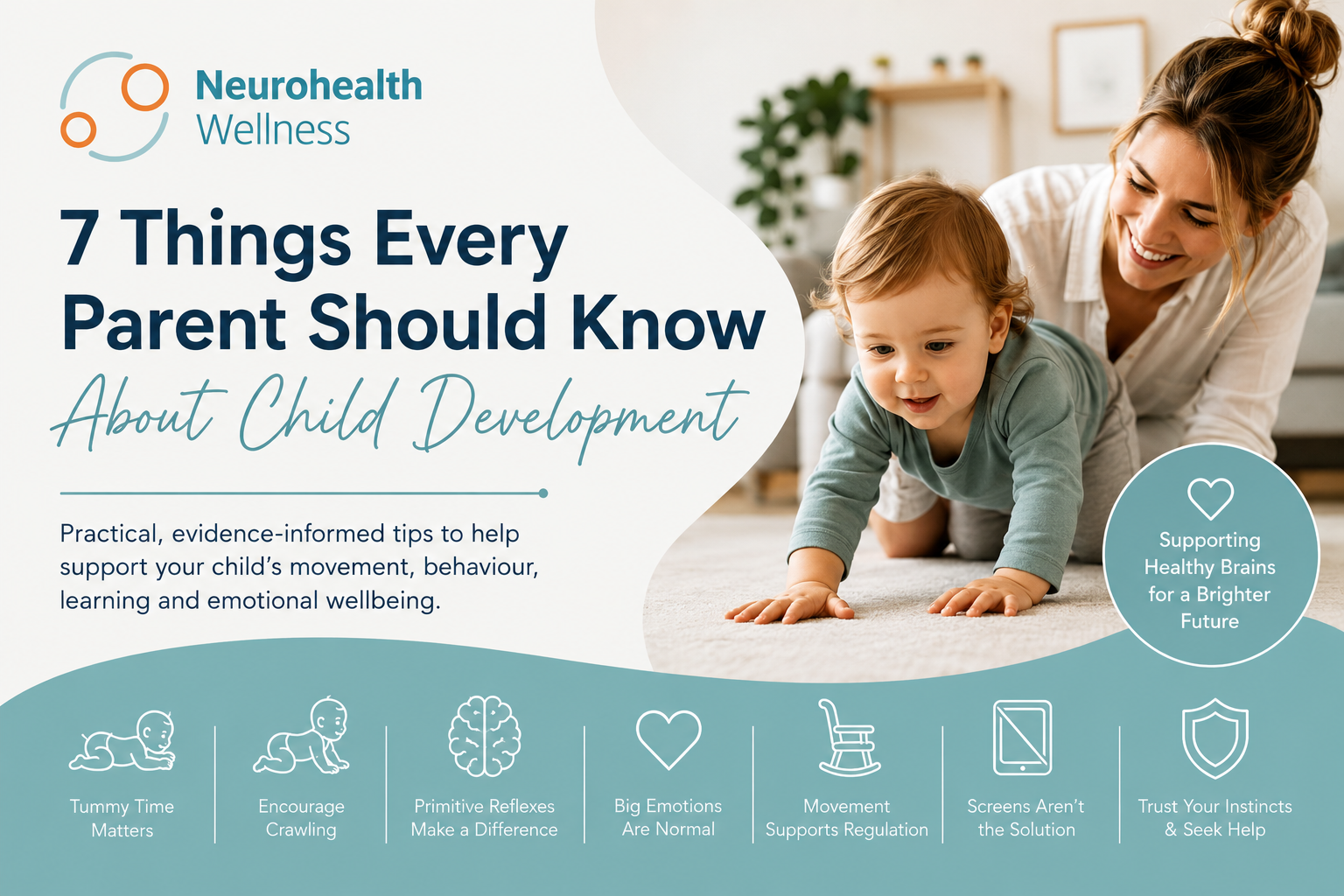
Things I Wish Every Parent Knew About Their Child's Development
Parenting doesn't come with a manual.
Every stage brings new questions. Is my baby developing normally? Should they be walking yet? Are tantrums just part of growing up? Is my child's behaviour something they'll grow out of, or should I be concerned?
As healthcare practitioners, we regularly meet parents who tell us they wish they had known more about early childhood development before these questions arose.
The good news is that many of the most important foundations for healthy movement, learning, emotional regulation and brain development begin in the first few years of life—and there are simple things parents can do to support them.
Here are some of the biggest lessons we wish every parent knew.
1. Tummy Time Really Does Matter
Many babies aren't enthusiastic about tummy time at first—and that's completely normal.
However, tummy time is one of the most important activities during infancy because it helps develop:
- Neck strength
- Shoulder stability
- Core muscles
- Postural control
- Head control
- Early coordination
These muscles become the foundation for rolling, sitting, crawling and eventually walking.
Rather than aiming for one long session, try multiple short periods throughout the day. Even a few minutes at a time can make a difference.
If your baby becomes upset, lying tummy-down on your chest or across your lap can be a great place to begin.
2. Don't Rush Walking—Celebrate Crawling
Many parents become excited when their baby starts pulling themselves up and taking their first steps.
But crawling is one developmental stage you don't want to skip.
Cross-pattern crawling—where the opposite arm and leg move together—helps develop communication between both sides of the brain while strengthening the muscles required for future movement.
Crawling also supports:
- Gross motor development
- Balance
- Spatial awareness
- Coordination
- Visual tracking
- Shoulder and hip stability
- Hand strength
Some babies naturally crawl for months, while others try to move quickly toward standing.
Whenever possible, encourage crawling and give your child plenty of opportunities to explore the floor before encouraging early walking.
3. Two-Year-Olds Are Supposed to Push Boundaries
If you're the parent of a toddler, this may come as a relief.
Tantrums.
Big emotions.
Testing limits.
Saying "no."
Wanting independence.
These behaviours are often a normal part of healthy development.
Around two years of age, children begin learning that they are separate individuals capable of making their own choices. Their emotional centres develop much faster than the parts of the brain responsible for self-control, planning and reasoning.
That means big emotions are expected.
Rather than asking, "How do I stop the tantrum?" it can be more helpful to ask:
"What is my child trying to communicate?"
Calm, consistent boundaries combined with reassurance help children gradually learn emotional regulation.
Interestingly, a child who never explores, never challenges boundaries or rarely expresses independence may also benefit from a developmental review, as this can occasionally indicate other developmental concerns.
4. Primitive Reflexes Shouldn't Stay Forever
Primitive reflexes are automatic movement patterns present from birth.
They help babies survive and develop during infancy before gradually becoming integrated as the nervous system matures.
Examples include:
- Moro Reflex
- Asymmetrical Tonic Neck Reflex (ATNR)
- Symmetrical Tonic Neck Reflex (STNR)
- Spinal Galant Reflex
- Palmar Reflex
When these reflexes remain active beyond the expected age, they may interfere with:
- Coordination
- Balance
- Posture
- Emotional regulation
- Attention
- Motor planning
- Executive functioning
- Learning
Around four years of age can be a valuable time for children to have these movement patterns assessed if there are concerns regarding coordination, behaviour, learning or emotional regulation.
Not every child with retained primitive reflexes experiences difficulties, and not every developmental challenge is caused by retained reflexes. However, they can form one important piece of a comprehensive developmental assessment.
5. Never Underestimate the Power of Movement
One of the simplest parenting tools is also one of the oldest.
A rocking chair.
Gentle rhythmic movement provides sensory input that many babies find calming and organising.
Movement stimulates the vestibular system—the body's balance system—which plays an important role in:
- Body awareness
- Balance
- Spatial orientation
- Postural control
- Nervous system regulation
Many parents notice their baby settles more easily with slow rocking than with constant stimulation.
Creating calm through movement rather than distraction can help children gradually learn to regulate themselves.
6. An iPad Stops the Tantrum - But Doesn't Teach Emotional Regulation
Screens are incredibly tempting.
After a long day, handing over a tablet can feel like the quickest solution.
Sometimes that's completely understandable.
However, if screens become the primary way children calm themselves, they may miss valuable opportunities to develop emotional regulation.
Learning to identify frustration, tolerate disappointment and recover from difficult emotions is an important developmental skill.
Instead of immediately reaching for a device every time emotions run high, consider strategies such as:
- Deep breathing together
- Gentle rocking
- Reading a book
- Quiet sensory play
- Outdoor movement
- Naming emotions
- Physical comfort and reassurance
These approaches help children gradually build lifelong emotional resilience.
7. Trust Your Instincts When Behaviour Changes Suddenly
Parents know their children better than anyone.
If your child's personality changes dramatically over a short period, it's worth seeking professional advice.
Signs that deserve assessment include:
- Sudden aggression
- Severe anxiety
- New obsessive behaviours
- Motor or vocal tics
- Emotional regression
- Major changes in mood or behaviour
These symptoms can have many possible causes, ranging from emotional stress to medical or neurological conditions.
In some situations, healthcare professionals may investigate conditions such as Paediatric Acute-onset Neuropsychiatric Syndrome (PANS) or Paediatric Autoimmune Neuropsychiatric Disorders Associated with Streptococcal Infections (PANDAS), alongside other medical explanations.
Early assessment helps ensure children receive appropriate care when needed.
How Neurohealth Wellness Can Help
At Neurohealth Wellness, we take a whole-child approach to development.
When appropriate, our assessments may include:
- Movement screening
- Posture assessment
- Gross and fine motor development
- Balance and coordination
- Primitive reflex screening
- Nervous system function
- Age-appropriate developmental milestones
Our goal is not simply to identify problems but to understand how your child's nervous system, movement and development are working together so we can provide practical guidance for families.
Every child develops at their own pace, and variation is completely normal. When concerns arise, however, early assessment can provide reassurance, identify areas that may benefit from support and help families make informed decisions.
Final Thoughts
Parenting is one of life's greatest adventures, and no parent gets everything right.
Children don't need perfect parents—they need attentive ones.
Simple things like encouraging tummy time, allowing plenty of crawling, supporting emotional regulation and recognising when something doesn't seem quite right can have a meaningful impact on healthy development.
If you've been wondering whether your child's movement, posture, coordination or development is progressing as expected, our team is here to help.
Sometimes peace of mind starts with simply asking the question.
Book a Developmental Assessment at Neurohealth Wellness
If you have concerns about your child's movement, coordination, posture, primitive reflexes or overall development, we'd love to help.
Contact Neurohealth Wellness today to arrange an assessment and receive personalised guidance tailored to your child's stage of development.


