


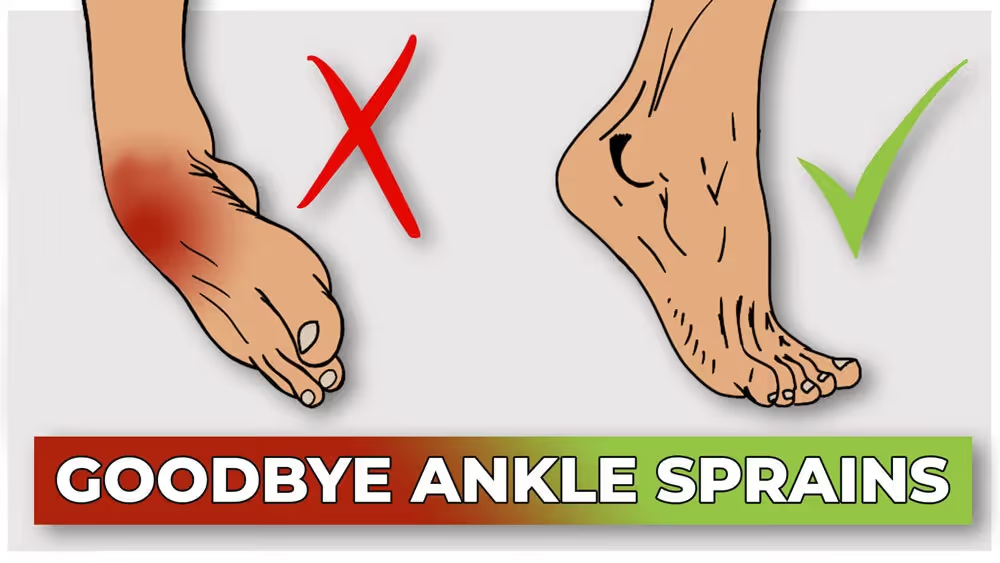
Wobbly Ankles: Why Ankle Sprains Happen — and How to Rebuild Strong, Stable Ankles for Life
Ankle injuries are among the most common acute sporting injuries worldwide. In women’s gymnastics, the ankle is the single most injured area of the body. Here at Neurohealth Wellness on Sydney’s Northern Beaches, our chiropractors regularly help gymnasts, netballers, basketballers, football players, dancers, and weekend warriors who have “rolled” their ankle — sometimes for the first time, but often after a long history of repeat sprains.
The good news? Your ankle can become stronger and more stable than before, provided you rehabilitate it properly. Unfortunately, many people stop rehab too early, leading to long-term instability, chronic pain, and a cycle of recurring injuries.
Today’s blog dives deeply into:
- What actually happens during an ankle sprain
- Why some people develop “wobbly ankles”
- The step-by-step process to heal and prevent reinjury
- How our multidisciplinary team at Neurohealth supports whole-body recovery
- Why restoring ankle stability is essential for future strength, mobility, and longevity
This blog aligns with our clinic’s core philosophy:
Long-term resilience is built from the ground up — especially the feet and ankles.
What Exactly Happens When You Sprain Your Ankle?
An ankle sprain occurs when the foot twists either:
- Inwards (inversion) → the most common type, causing a lateral ankle sprain
- Outwards (eversion) → causing a medial ankle sprain
This sudden force overstretches or tears the ligaments that hold the ankle stable.
Common Causes Include:
- Sudden changes of direction
- Landing awkwardly
- Uneven surfaces
- Fatigue during sport
- Wearing unstable, cushioned, or worn-out footwear
- Weak calf or foot muscles
- Poor proprioception
Some people hear a loud crack or pop — this can sound dramatic, but it doesn’t necessarily indicate injury severity.
Could It Be a Fracture?
In higher-force injuries, fractures can occur. Our chiropractors at Neurohealth Wellness use validated orthopaedic tests (similar to physiotherapists) to determine whether X-rays are needed. If we suspect fracture, you’ll be referred immediately.
Important Anatomy: Why Ligaments Matter
Ligaments stabilise joints and act as sensors to your nervous system. When overstretched or torn, they lose some of that stabilising function.
Different ligaments are injured depending on the angle of the sprain. Sometimes the bones collide, causing a “kissing lesion” — a type of bone bruise opposite the torn ligament.
Although swelling is immediate, the most accurate ligament testing is done 5–7 days post-injury, once protective swelling has reduced.
Why Some People Get “Wobbly Ankles”
Once you’ve sprained your ankle, the proprioceptive system is disrupted. This is your body’s internal GPS — the sense of where your joints are in space. Without good proprioception, stability becomes inconsistent.
Signs of poor proprioception include:
- Feeling unsteady on uneven surfaces
- Frequent rolling of the ankle
- Difficulty balancing on one leg
- Feeling “weak” or “loose” in the ankle
- Poor confidence when running, jumping, or landing
The good news:
Proprioception can be rebuilt — and often becomes better than before the injury.
The Neurohealth Approach: Rebuilding the Ankle for Real-World Demands
We don’t just help your ankle heal — we help it become more resilient than before.
Our rehabilitation method focuses on:
- Swelling reduction
- Restoring mobility
- Rebuilding strength
- Restoring proprioception
- Sport-specific preparation
- Whole-body optimisation
This integrates our clinic’s philosophy from our other blogs, such as:
- Restoring resilient feet (internal link: “Why You Need Resilient Feet (and How to Rebuild Them)”)
- Building core stability (internal link: “The Best Core Workout: Build Stability and Power”)
- Posture and neck health (internal link to combined posture & neck blog)
- How to stretch intelligently (internal link to Huberman stretching blog)
Everything in the body is connected — a weak foot changes your knee load, hip activation, pelvic balance, and even spinal stabilisation. An ankle sprain is never just an ankle sprain.
1. Reduce Swelling and Promote Circulation
Early management sets the tone for your recovery.
At Neurohealth Wellness, we focus on active healing, not outdated protocols that promote total rest.
We help reduce swelling with:
- Compression
- Elevation
- Cupping (offered by both our chiropractors and Ana, our myotherapist)
- Soft tissue work to reduce muscle guarding
- Gentle movement to promote blood flow
We avoid excessive icing, which can slow certain phases of tissue healing.
2. Restore Pain-Free Range of Motion (Especially Dorsiflexion)
Dorsiflexion — pulling the foot up toward your shin — is often the first movement to disappear after an ankle sprain. Without it, tasks like running, squatting, descending stairs, or landing from jumps become difficult.
Our chiropractors use:
- Joint mobilisations
- Chiropractic adjustments
- Targeted stretching
- Movement retraining
Regaining this motion early reduces the risk of chronic ankle stiffness or recurrent sprains.
Interested in learning more about mobility?
See our blog on science-based stretching inspired by Dr Andrew Huberman.
3. Rebuild Strength in the Calf and Foot Muscles
Strength loss is expected after a sprain due to swelling, pain avoidance, or immobilisation.
The calves perform more work at the ankle during walking and running than the hip and knee muscles combined. Your foot’s intrinsic muscles also stabilise your arch and help control balance.
Your rehab program will include:
- Progressive calf raises (straight and bent knee)
- Intrinsic foot strengthening (short-foot exercises, toe articulation work)
- Glute and hip strengthening
- Hamstring and quad activation
- Trunk stabilisation work
This aligns with our “strong feet, strong body” ethos from our Resilient Feet blog.
We emphasise strengthening before returning to running, jumping, or high-speed direction changes.
4. Restore Proprioception and Balance — The Most Overlooked Step
Proprioception is your body’s ability to sense joint position and maintain balance.
After a sprain, this system becomes impaired.
Without restoring it, reinjury becomes far more likely.
We rebuild proprioception using:
- Single-leg balance
- Eyes-closed balance drills
- Wobble boards / BOSU
- Barefoot movement training
- Dynamic stability drills
- Foot-strengthening progressions
Combined with chiropractic care to improve foot and ankle joint mechanics, this step dramatically improves long-term stability.
5. Sports-Specific Rehabilitation
Returning to sport safely requires training that mimics real movements.
Gymnasts:
- Pointe and relevé work
- Landing mechanics
- Rebounding
- Sprinting
- Beam-specific stability
Runners:
- Cadence optimisation
- Foot strike control
- Plyometric progression
- Calf complex strengthening
Soccer / Netball / AFL:
- Cutting and pivoting drills
- Acceleration and deceleration
- Lateral hops
- Reactive agility drills
Dancers:
- Turnout control
- Foot articulation
- Single-leg balance transitions
Your program progresses from slow and controlled → fast and reactive.
6. Whole-Body Assessment and Treatment
A strong ankle requires a strong kinetic chain.
At Neurohealth Wellness, your ankle rehab also looks at:
- Hip strength and pelvic control
- Core stability (linked to our Core Workout blog)
- Foot mechanics
- Gait efficiency
- Thoracic and lumbar mobility
- Posture foundations (linked to our sitting posture & neck health blog)
This holistic approach is why so many patients who struggled for years finally experience long-lasting stability.
How Each Practitioner at Neurohealth Helps
Chiropractors (Steve, Florian & team)
- Diagnose ligament injury grade
- Mobilise and adjust the ankle, foot, knee, hip and spine
- Provide targeted strengthening and mobility exercises
- Perform dry needling or cupping when appropriate
- Guide sport-specific progressions
- Address compensations in the kinetic chain
Ana — Massage/Myotherapy
Ana provides:
- Soft tissue therapy
- Cupping
- Swelling reduction
- Muscle balance restoration
- Support for athletes with heavy training loads
Lucia — Acupuncture
Acupuncture may help with:
- Reducing acute pain
- Improving circulation
- Supporting tissue healing
- Calming the nervous system
- Reducing muscle guarding
Katarina — Hypnotherapy & NLP
Helpful especially for athletes with fear-avoidance after injury:
- Overcoming landing or movement anxiety
- Rebuilding confidence in sport
- Enhancing mind-body awareness
- Improving focus and performance
Many chronic ankle sprain patients lose trust in their body. Hypnotherapy can help restore this connection.
Why Proper Rehabilitation Matters (The Statistics Are Sobering)
Studies show:
- Up to 70% of ankle sprains will recur if the first injury is not properly rehabilitated
- Up to 40% of people develop chronic ankle instability
- Reduced ankle mobility increases knee, hip and low back loading
You can’t build a strong, resilient body on unstable ankles.
As we emphasise in our Resilient Feet, Core Training, and Neck/Posture blogs — the body works best when its foundations are strong.
Final Thoughts: Build Stability Now, Prevent Injury Later
An ankle sprain doesn’t have to be the beginning of recurring injuries. With comprehensive, whole-body rehabilitation, your ankles can become stronger, steadier, and more resilient than ever.
Whether you’re recovering from an acute sprain or dealing with years of instability, our team at Neurohealth Wellness is here to help you move confidently again.
Ready to Rebuild Strong, Stable Ankles?
📍 Neurohealth Wellness — 33–35 Kentwell Rd, Allambie Heights (near Brookvale)
📞 (02) 9905 9099
💻 Book online: www.neurohealthwellness.com.au/booking
References
- Hertel J. Functional instability following lateral ankle sprain. Sports Med. 2000.
- Doherty C et al. The incidence and prevalence of ankle sprain injury: a systematic review. Sports Med. 2014.
- Delahunt E et al. Clinical assessment of acute lateral ankle sprain injuries (ICL Science & Medicine).
- Hubbard TJ, Wikstrom EA. Ankle sprain: pathophysiology and implications for rehabilitation. J Athl Train. 2010.
- Kaminski TW et al. National Athletic Trainers’ Association position statement: conservative management of ankle sprains. J Athl Train. 2013.
- Verhagen E & Bay K. Optimising ankle sprain prevention. Br J Sports Med. 2010.
- Gribble P et al. Proprioceptive deficits in chronic ankle instability: a systematic review. J Orthop Sports Phys Ther. 2016.


