


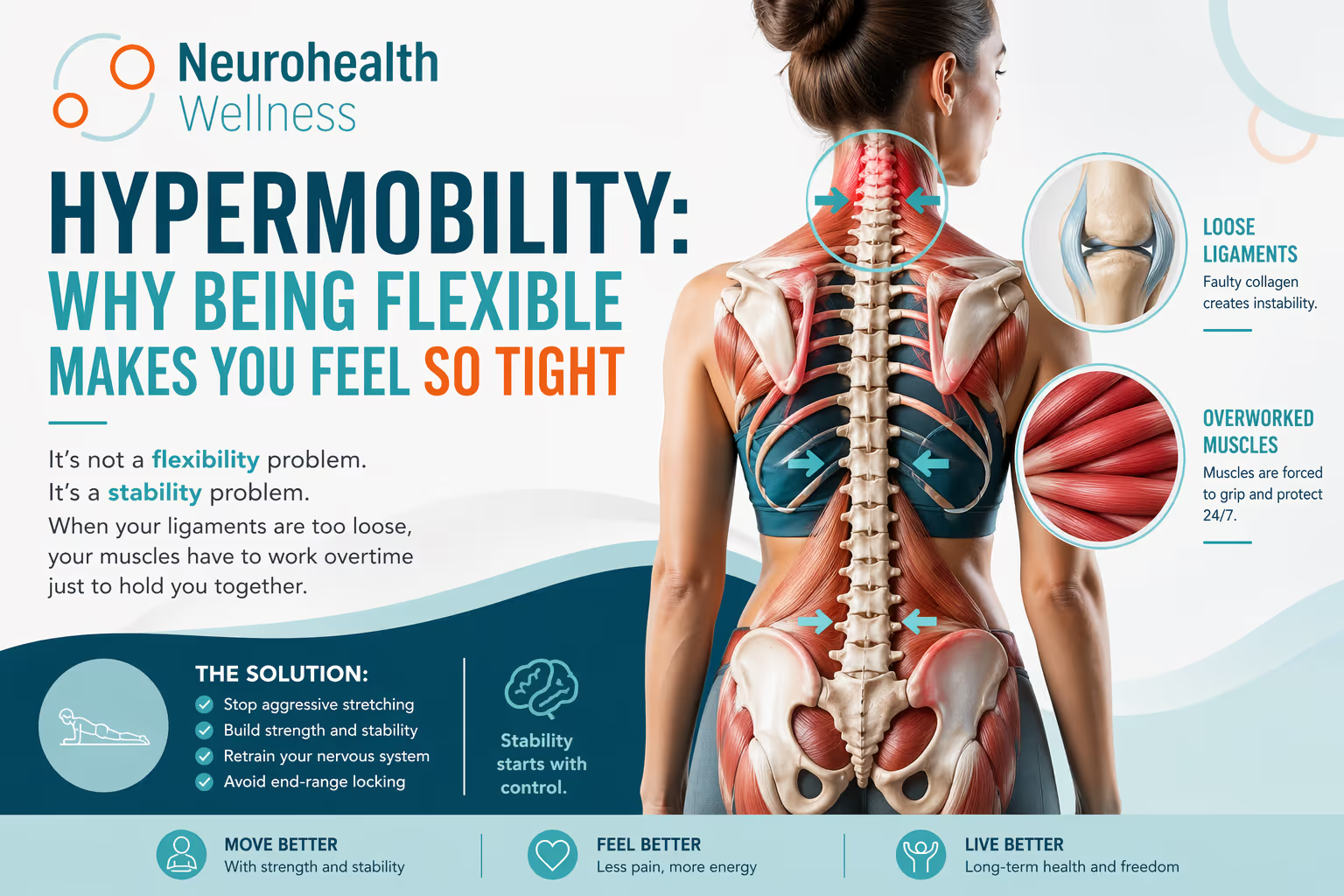
You’ve always been the “flexible” one. You can stretch further, bend deeper, and move in ways others can’t. But here’s the frustrating truth—your body feels constantly tight, sore, and exhausted. At Neurohealth Wellness on Sydney’s Northern Beaches, we see this paradox every day. And the answer isn’t more stretching—it’s understanding how your nervous system and connective tissue are working overtime just to hold you together.
The Flexibility Trap: Why More Stretching Isn’t the Answer
Are you constantly stretching your neck, hips, or hamstrings—only to feel tight again within hours?
That’s the hallmark of hypermobility.
People with hypermobile joints (sometimes diagnosed as Ehlers-Danlos Syndrome or generalised joint hypermobility) often live in a frustrating cycle:
- Stretch → temporary relief
- Tightness returns → stretch again
- Pain increases over time
This isn’t a flexibility issue. It’s a stability problem driven by your nervous system.
The Anatomy: When Your “Support System” Fails
Your body relies on two main systems for support:
1. Passive Stability (Ligaments)
Ligaments are strong bands of connective tissue that:
- Hold bones together
- Limit excessive movement
- Provide structural integrity
Think of them as your body’s built-in “duct tape.”
2. Active Stability (Muscles)
Muscles:
- Move joints
- Control movement
- React to instability
In a healthy system, ligaments do most of the stabilising at rest, so muscles can relax.
The Biomechanical Problem in Hypermobility
In hypermobile individuals:
- Collagen is more elastic
- Ligaments are too loose
- Joints move beyond normal ranges
This means your passive stability system fails.
Your brain recognises this instantly.
The Nervous System Response: Survival Mode
To prevent injury or dislocation, your nervous system shifts strategy:
👉 Muscles take over the job of ligaments
This leads to:
- Constant low-level muscle contraction
- Protective guarding around joints
- Chronic fatigue in stabilising muscles
That “tightness” you feel?
It’s not stiffness.
It’s your muscles working overtime to keep you safe.
Why You Always Feel Tight (Even If You’re Flexible)
This is where most people get it wrong.
❌ It’s NOT because you need more stretching
✅ It’s because your muscles can’t switch off
Your body is stuck in a loop:
- Joint instability detected
- Muscles tighten to protect
- You stretch → more instability
- Brain increases muscle tension
And the cycle continues.
Common Signs of Hypermobility-Driven Tightness
You might relate to this if you:
- Feel tight everywhere despite stretching regularly
- Have frequent neck, shoulder, or hip pain
- Experience joint clicking, popping, or instability
- “Lock out” your knees or elbows without thinking
- Feel fatigued after standing or sitting for long periods
- Have a history of sprains, strains, or “mystery pain”
How to Break the Cycle (The Neurohealth Approach)
At Neurohealth Wellness, we don’t chase symptoms—we restore control, stability, and nervous system balance.
1. Stop Aggressive Stretching
Stretching already loose joints:
- Increases instability
- Forces muscles to tighten more
- Worsens long-term pain
Instead, think:
👉 “Control over range” rather than “more range”
2. Build Stability First (Not Flexibility)
Focus on:
- Isometric exercises (planks, holds, controlled positions)
- Slow, controlled strength work
- Joint-centred stability training
This teaches your brain:
👉 “This joint is safe. You can relax.”
3. Avoid End-Range Locking
Small changes = big difference:
- Keep a micro-bend in knees when standing
- Avoid locking elbows during lifting
- Stay out of extreme joint positions
This reduces the need for emergency muscle tension.
4. Retrain Your Nervous System
This is where chiropractic care plays a key role.
At Neurohealth Wellness, our chiropractors:
- Assess joint control and movement patterns
- Restore proper joint mechanics
- Improve communication between brain and body
Because ultimately:
👉 Stability is a neurological skill, not just a strength issue
Why This Matters for Long-Term Health
Left unaddressed, hypermobility can lead to:
- Chronic pain syndromes
- Recurrent injuries
- Early joint degeneration
- Nervous system fatigue
But when you shift the focus to stability, control, and nervous system regulation, everything changes:
- Muscles relax
- Pain reduces
- Movement feels effortless again
If you’re constantly tight despite stretching, your body is trying to tell you something deeper.
👉 Book your New Patient Chiropractic Assessment
https://www.neurohealthwellness.com.au/booking
📞 (02) 9905 9099
Let’s assess your stability, movement, and nervous system—so you can finally break the cycle.
The Bigger Picture: It’s Not Just Your Muscles
Hypermobility isn’t just a structural issue.
It’s a whole-body condition involving:
- Connective tissue
- Nervous system regulation
- Movement control
- Fatigue and recovery capacity
That’s why at Neurohealth Wellness, our team—including chiropractic, massage therapy, acupuncture, and hypnotherapy—works together to support:
- Physical stability
- Mental resilience
- Long-term health outcomes
Being flexible isn’t the advantage you thought it was—unless it’s paired with control.
If you feel constantly tight, your body isn’t asking for more stretching.
It’s asking for:
👉 Stability
👉 Strength
👉 Safety
Ready to stop chasing tightness and start building real stability?
👉 Book your assessment today:
https://www.neurohealthwellness.com.au/booking
Or call us on 📞 (02) 9905 9099
Let’s help you move better, feel stronger, and live pain-free.
Further Reading
References
- Castori M. (2012). Ehlers-Danlos Syndrome and Hypermobility Spectrum Disorders.
- Russek LN. (1999). Hypermobility syndrome. Physical Therapy.
- Rombaut L et al. (2015). Muscle-tendon tissue properties in hypermobility.
- Scheper MC et al. (2017). Generalised joint hypermobility and muscle function.
- Hodges PW & Tucker K. (2011). Moving differently in pain. Pain.
- Engelbert RH et al. (2017). Exercise in hypermobility disorders.


