


The Three-Phase Effect: How to Turn Stretching Into Lasting Mobility
Have you ever finished a stretching session feeling looser, only for the tightness to return later that day?
The problem may not be that you need to stretch harder. It may be that your routine stops just as the useful work is beginning.
A practical way to think about mobility training is in three phases:
- 0–30 seconds: settle the nervous system and reduce guarding
- 30–90 seconds: spend meaningful time in the position
- 90+ seconds: add strength and control in the new range
This is not a biological stopwatch. Your tissues do not suddenly “release” at 30 seconds or become permanently longer at 90 seconds. The timing is better understood as a coaching framework: first settle into the position, then allow time for the stretch to become comfortable, and finally teach your body to control the range you have accessed.
That final step matters. If your nervous system does not feel that you can control a position, it may continue to limit it with protective muscle tone. Passive flexibility can give you access to a range; active strength helps you use and retain it.
Why a muscle can feel tight without being physically short
We often talk about a “tight” muscle as though it were a rope that simply needs to be pulled longer. Human movement is more complex.
The sensation of tightness may reflect several factors, including:
- muscle and tendon stiffness
- sensitivity to stretch
- fatigue or recent training load
- pain or irritation
- unfamiliarity with a position
- reduced strength or coordination near the end of the available range
- a protective response from the nervous system
Your brain continually assesses whether a movement feels tolerable and controllable. When a position feels unfamiliar, painful or unstable, the body may increase muscle activity or create a strong stretching sensation before you reach the joint’s full available range. This is not the body “failing”; it is a protective strategy.
A 2025 systematic review and meta-analysis suggests that improvements in range of motion after stretching involve changes in overall stiffness and, with repeated training, an increased tolerance of the stretching sensation. Importantly, current evidence does not support the idea that every short stretch permanently lengthens muscle fibres or fascia. Lasting mobility is developed through repeated exposure over weeks, not one heroic session.
Phase 1: 0–30 seconds — reduce guarding
The first part of a stretch is often an introduction to the position.
If you move quickly to your maximum range, hold your breath and brace, your nervous system may interpret the position as a threat. The result is often more resistance rather than less.
During the first 30 seconds:
- move only to mild or moderate tension
- keep the position stable and supported
- breathe slowly, with a longer relaxed exhalation
- allow unnecessary bracing in the jaw, shoulders and abdomen to reduce
- avoid bouncing or forcing the joint farther
You are not trying to switch a muscle “off”. Muscles need some tone to support the body. The goal is to reduce unnecessary guarding so that you can explore the position with less resistance.
For some people, 15–30 seconds is enough to improve range temporarily. Others need longer to become comfortable. Age, training history, pain, stress, temperature and the specific muscle group can all affect the response.
Phase 2: 30–90 seconds — give the position time
Once the initial resistance settles, you can spend more time at a tolerable end range.
This stage is often described as “fascial release” or “tissue lengthening”. Those phrases can be useful shorthand, but they should not be taken to mean that fascia suddenly melts or that the muscle permanently lengthens within a minute. During a sustained stretch, the muscle–tendon unit can become temporarily less resistant, the sensation of stretch can become more tolerable and you may be able to move slightly farther without forcing.
Over repeated sessions, stretch training can improve range of motion. A 2024 systematic review found a moderate improvement in range following regular stretching interventions, while the newer review above reported that chronic changes were associated with both reduced stiffness and increased stretch tolerance.
The practical lesson is simple: time under gentle, controlled tension can help, but consistency across weeks matters more than chasing one very long hold.
During this phase:
- stay below sharp, pinching or electrical pain
- use calm breathing rather than pushing harder
- make very small adjustments only if the position becomes easier
- aim for a feeling of productive tension, not strain
For general flexibility work, 30–60 seconds can be a useful starting range. Longer is not automatically better, and very long passive holds are not necessary for every person or every muscle.
Phase 3: 90+ seconds — build strength in the new range
This is where stretching becomes mobility training.
Rather than remaining passive indefinitely, begin to create gentle muscular effort near the end range. You may press into the floor, lift away from a support, hold the joint actively or move slowly in and out of the position.
This helps “close the gap” between:
- passive range: how far an external force, gravity or a support can take you
- active range: how far you can move and control using your own muscles
If you can drop into a deep position with assistance but cannot hold or leave it without using your hands, you have flexibility that your body does not yet fully control. It makes sense that the nervous system may remain cautious there.
A systematic review comparing strength training with stretching found no significant difference between the two approaches for improving range of motion in the included healthy populations. Research also indicates that resistance training through a full range can improve strength and some functional outcomes. This does not mean everyone should load their deepest possible range immediately. It means that progressively strengthening the range you can safely access is an important part of making it useful.
A simple sequence is:
- Settle into a supported stretch.
- Hold at mild-to-moderate tension for 30–60 seconds.
- Add a gentle isometric contraction for 10–20 seconds.
- Relax briefly.
- Actively move through the range for 5–8 controlled repetitions.
Start with about 20–30% effort. More intensity is not automatically more effective, particularly if you are new to end-range training or managing pain.
For a more advanced progression, explore these end-range contraction methods, including PAILs and RAILs.
Three examples for hip mobility and the lower back
The following examples are general options for people who are currently pain-free with these movements. They are not a diagnosis or a personalised rehabilitation plan.
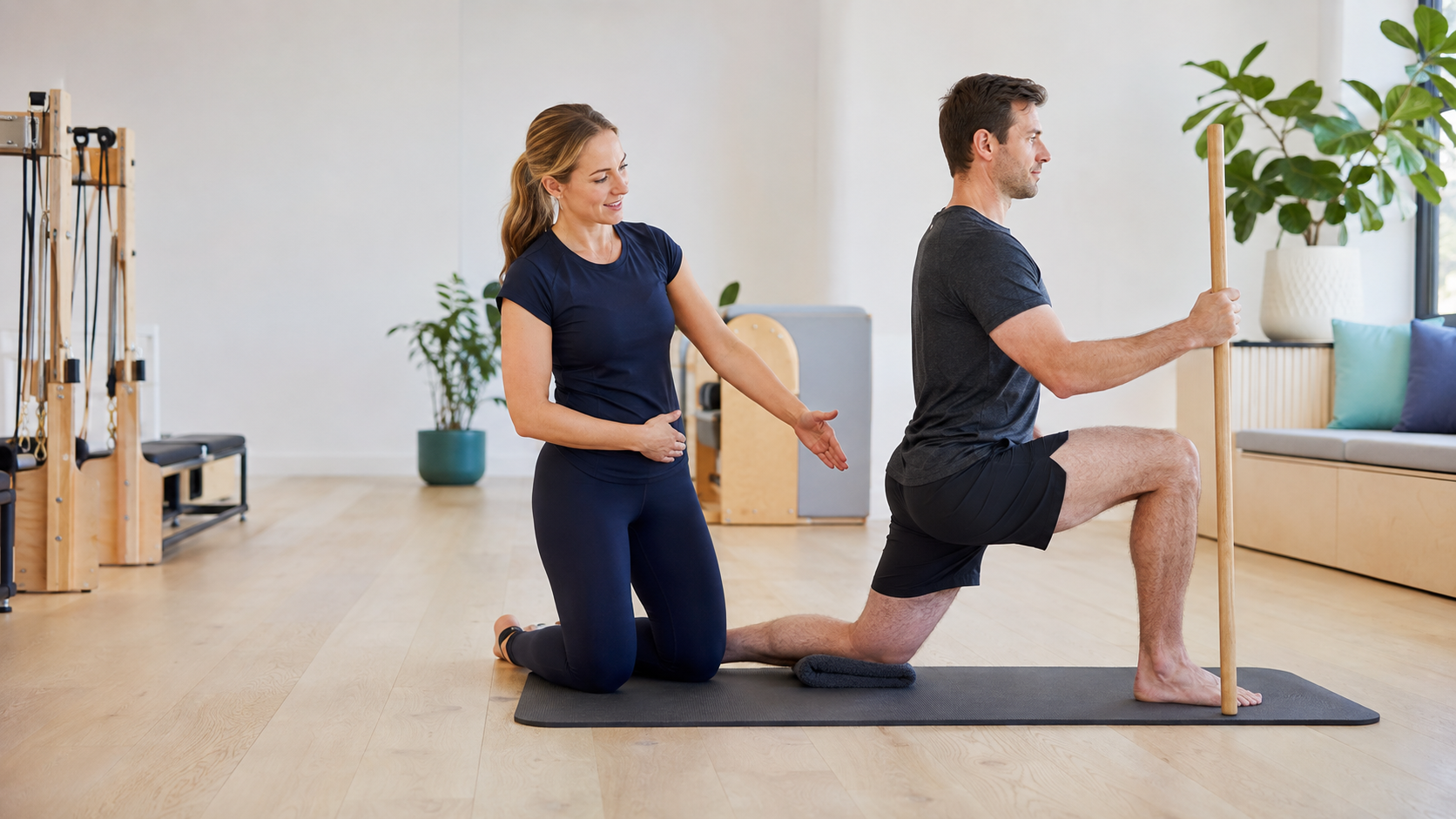
1. Half-kneeling hip flexor stretch to split-squat control
If this area repeatedly feels restricted, learn more about the relationship between tight hip flexors and back pain.
This sequence targets the front of the hip while teaching the glutes and legs to control hip extension.
Phase 1 — settle:
Kneel on a padded surface with one foot forward. Gently tuck the pelvis as though bringing your belt buckle towards your ribs. Squeeze the glute on the kneeling side and move forward only until you feel a mild stretch at the front of that hip. Hold for about 20–30 seconds while breathing slowly.
Phase 2 — spend time:
Maintain the pelvic position for another 30–45 seconds. Avoid gaining range by arching the lower back.
Phase 3 — strengthen:
Without moving, gently drag the kneeling knee forward and the front heel backwards against the floor, as though trying to pull the legs together. Hold for 10 seconds, relax, and repeat two or three times. Then perform 6–8 slow split squats in a comfortable range, using support if needed.
Why it may last better: you have not only accessed hip extension; you have asked the surrounding muscles to produce force and maintain pelvic control there.
2. Supported 90/90 hip rotation with lift-offs
This drill works on hip rotation, which is useful for squatting, changing direction, getting up from the floor and many sporting movements.
Phase 1 — settle:
Sit in a 90/90 position with both knees bent. Place your hands on the floor or on yoga blocks so the position feels stable. Sit tall and breathe for 20–30 seconds.
Phase 2 — spend time:
Hinge your chest slightly over the front shin while keeping the movement at the hip rather than rounding aggressively through the lower back. Hold for another 30–45 seconds at a tolerable intensity.
Phase 3 — strengthen:
Return upright. Keeping the front knee down, try to lift the front ankle a few millimetres from the floor. It may not move at first—the muscular effort still counts. Hold for 5–10 seconds and repeat three times. Finish with 5 slow 90/90 transitions from side to side, using your hands as little as you comfortably can.
Athletes can find additional sport-specific advice in our guide to hip mobility for athletes.
Why it may last better: the hip rotators learn to create and control movement instead of relying entirely on body weight to push the joint into position.
3. Supported squat hold to controlled squat
A squat combines mobility at the hips, ankles and trunk. It can also be a useful way to teach the body to tolerate a deeper hip position without forcing the lower back.
Phase 1 — settle:
Hold a stable bench, door frame or mobility stick and lower into a comfortable squat. Keep your feet fully supported. Stop before pain, pinching or loss of balance. Breathe for 20–30 seconds.
Phase 2 — spend time:
Remain supported for another 30–45 seconds. Gently shift a small amount from side to side if that feels comfortable. Do not force the knees or round the lower back to chase depth.
Phase 3 — strengthen:
Press your feet into the floor and reduce the amount of support from your hands. Hold for 5–10 seconds, then stand slowly. Complete 5–8 controlled squats to the same depth. A box or chair can provide a consistent target.
Why it may last better: the new depth becomes part of a movement you can enter and leave under your own control.
To develop better control when bending, lifting and loading the hips, learn the hip-hinge pattern.
What about stretching the lower back directly?
For some people, gentle spinal movement feels relieving. For others—particularly those with acute pain, nerve irritation or sensitivity to bending—trying to force a large lower-back stretch can aggravate symptoms.
The lower back often benefits from a combination of comfortable movement and trunk control rather than maximal end-range stretching. A simple alternative is:
- 5–8 gentle cat-camel movements, staying within a comfortable range
- 6–8 quadruped rock-backs, keeping the spine quiet while the hips move
- 5 bird-dog holds per side, each for 5–10 seconds
This sequence lets the spine move, encourages the hips to contribute and then reinforces control. A Cochrane review supports exercise for chronic non-specific low back pain, although no single exercise suits everyone and average benefits are generally modest. The best program is one matched to the person, their symptoms and the movements they need in daily life.
How often should you use the three-phase method?
For one or two restricted areas, try the sequence two to four times per week. A short, repeatable routine is usually more useful than an exhausting session that leaves you sore and is abandoned after a week.
Use these guidelines:
- work at mild-to-moderate stretch intensity
- use stable positions and supports when needed
- begin end-range contractions gently
- build range or load gradually, not both at once
- assess progress by movement quality and function, not only how far you can push
- include normal strength training, walking and varied daily movement
You can also explore more ways to improve mobility naturally, including daily movement, recovery and strength training.
Before sport, favour a dynamic warm-up and shorter mobility work. Save longer static holds and stronger end-range contractions for a separate mobility session or after training, because prolonged intense stretching immediately before explosive activity can temporarily reduce force production in some circumstances.
When to stop and seek advice
Stretching should create tension, not sharp or escalating pain. Stop and seek assessment if a movement causes:
- pins and needles, numbness or electric pain
- pain travelling down the leg
- marked weakness or loss of coordination
- dizziness or feeling unwell
- hip or groin pinching that worsens as you continue
- symptoms that remain substantially worse after the session
Urgent medical assessment is appropriate for new loss of bladder or bowel control, numbness around the saddle area, rapidly worsening leg weakness, significant trauma, fever with back pain, or unexplained weight loss.
The lasting-mobility takeaway
Stretching can improve range of motion, but a temporary feeling of looseness is not the same as durable, usable mobility.
Think of the three phases as a progression:
- relax: reduce unnecessary guarding
- explore: spend controlled time in the position
- own: build strength and coordination near the end range
The aim is not to force your body to surrender. It is to give it repeated evidence that the range is comfortable, controlled and useful.
If hip or lower-back stiffness keeps returning, a movement assessment can help identify whether the main limitation is mobility, strength, joint irritation, load tolerance or another factor. The team at Neurohealth Wellness in Allambie Heights can assess how you move and develop an individual plan suited to your goals.
If stiffness keeps returning, book a movement assessment with the Neurohealth Wellness team or call (02) 9905 9099.
This article provides general health information and does not replace individual assessment, diagnosis or treatment. Exercise suitability varies, particularly during injury, pregnancy or after surgery.
References
- Ingram LA, et al. Mechanisms underlying range of motion improvements following acute and chronic static stretching: a systematic review, meta-analysis and multivariate meta-regression. Sports Medicine. 2025. PubMed
- Konrad A, et al. Chronic effects of stretching on range of motion with consideration of potential moderating variables: a systematic review with meta-analysis. Journal of Sport and Health Science. 2024;13(2):186–194. PubMed
- Afonso J, et al. Strength training versus stretching for improving range of motion: a systematic review and meta-analysis. Healthcare. 2021;9(4):427. PubMed
- Alizadeh S, et al. Resistance training induces improvements in range of motion: a systematic review and meta-analysis. Sports Medicine. 2023;53:707–722. PubMed
- Pallarés JG, et al. Effects of range of motion on resistance training adaptations: a systematic review and meta-analysis. Scandinavian Journal of Medicine & Science in Sports. 2021;31(10):1866–1881. PubMed
- Hayden JA, et al. Exercise therapy for chronic low back pain. Cochrane Database of Systematic Reviews. 2021;9. PubMed


